The builder's own engineering
We are the manufacturer's own U.S. representative, so the engineering answers come from the people who build the machine and you reach them through one number.

Cresswood builds single-shaft, low-RPM wood waste shredders and grinders in Illinois, and has been family owned for sixty years. They are the machine at the end of a line: whatever your saws leave on the floor, this is what turns it back into something with a value. US Machinery Sales quotes and supports the range nationwide.
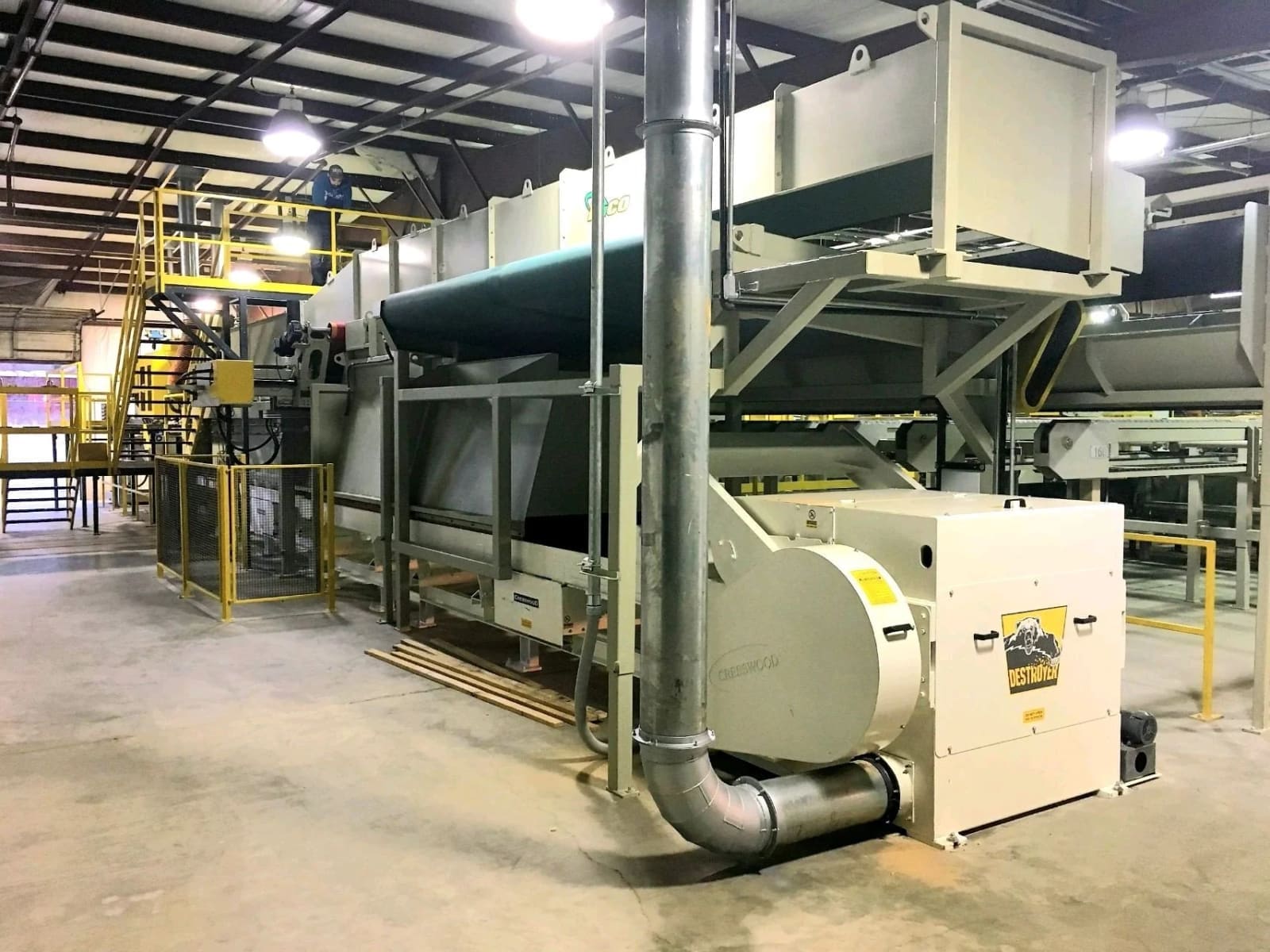
Cresswood designs, builds and installs industrial shredders in Illinois. The company describes sixty years of business with the same family, and describes itself as a family owned Midwestern business that treats its people accordingly. In a market where a lot of equipment arrives from a catalog with a badge on it, knowing who actually built the machine and that they will still be there in ten years is worth something on a purchase this size.
Everything they make is single-shaft and low RPM. That is not a range of options with a house style, it is the whole engineering position, and it is the thing to understand before comparing them with anything else.
A high-speed grinder solves the problem with rotational speed. A single-shaft, low-RPM machine solves it with torque: a slower rotor with more force behind it, pushing material against a screen until it is small enough to pass.
Three consequences follow, and all three matter more in a wood plant than the spec sheet suggests. It is more tolerant of the contamination that ends up in a real waste stream, because a slow rotor meeting a nail behaves very differently from a fast one. It is quieter, which changes where you are allowed to put it. And it makes less fine dust, which on a hardwood site is a fire, filtration and housekeeping question rather than a comfort one.
Throughput figures are the obvious thing to ask for and we deliberately do not publish them here, because the honest answer depends on the species, the moisture, the piece size and the screen you choose. We would rather size it against your actual stream than print a number you could hold us to and then miss.
Untreated waste is pure cost: you handle it twice, store it, and pay someone to take it. Ground to a consistent size it becomes saleable material, boiler fuel, animal bedding or mulch stock, depending on your species and your local market.
On a hardwood flooring plant the volume is larger than most owners expect, because the optimizer upstream is deliberately rejecting everything that will not make grade. That material is clean, dry and single species, which is the best-case input for a grinder and the easiest to find a buyer for.
We quote the machine with Cresswood's own application engineering behind it, and the same number covers wear parts and service afterwards. The specification fliers for every model family are on this page, and the video library carries a substantial amount of real footage of these machines running and being maintained, which is the fastest way to understand what you are buying.
| Model family | Type | What it is typically fed |
|---|---|---|
| EF-12SR | Single-shaft, low RPM | Smaller in-plant streams, tight footprint |
| EF-24SR / 36SR / 48SR | Single-shaft, low RPM | Offcuts and trim from a flooring or dimension line |
| EF-30LR / 50LR / 60LR | Single-shaft, long rotor | Longer material, whole pieces off the end of a line |
| SR360 | Single-shaft | Continuous in-plant wood waste |
| XR400 | Single-shaft grinder | Pallets and heavier mixed wood waste |
| XR500 / 600 / 700 | Single-shaft grinder | Higher-volume pallet and wood waste streams |
| XR2400 | Single-shaft grinder | Large-format and high-throughput streams |
| EXR-2000 | Single-shaft grinder | Heavy-duty continuous duty |
Configurations vary by mill. Ask which one fits your line.
Every cut you make creates waste, and every mill already pays to move it. A grinder at the end of the line turns offcuts, trim and rejected pieces into a sized material you can sell, burn for heat, or feed back rather than haul away.
It sits behind everything else: after the Lico rip and crosscut lines, after the edgers, after the sorter. What reaches it is whatever the optimizer decided was not worth keeping, which on a hardwood line is a genuinely large volume of clean, dry, single-species wood.
Lico lists Cresswood among its own supplier partners, so on a new line the waste end can be scoped in the same conversation as the saws instead of being solved a year later.
We are the manufacturer's own U.S. representative, so the engineering answers come from the people who build the machine and you reach them through one number.
We quote and support installations across the United States, from the Southeast to the Pacific Northwest.
Ripping, edging, scanning, sorting, stacking and waste handling on one quote, with the handoffs between them worked out before you order.
US Machinery Sales quotes, supplies and supports Cresswood shredders and grinders nationwide, with the builder's own application engineering behind the quote. Call Mike Rose on 615-948-9983.
A low-RPM single-shaft machine works by torque rather than speed. In practice that means it tolerates the tramp metal and contamination that finds its way into a real waste stream, it runs quieter, and it makes less fine dust than a high-speed machine working the same material. On a wood line, dust is not a nuisance, it is a fire and housekeeping problem.
It is decided by what you feed it and how continuously, not by plant size. The EF families suit offcuts and trim from a flooring or dimension line, the long-rotor versions take longer pieces, and the XR range is aimed at pallets and heavier mixed streams. Send us what comes off your line and we will size it with Cresswood.
Yes. The XR range is built for pallet and heavier mixed wood waste. That is a different duty from clean in-plant offcuts, so it is worth being explicit about the mix when you ask.
Wear parts and service come through the same number as the quote. Knives and screens are consumables on any grinder and their life depends entirely on what you run through it, so that is part of the sizing conversation rather than an afterthought.
Four builders, one contact. Each line picks up where the last leaves off, and most mills end up specifying two of them together.
Sizing, options, budget numbers and lead times, in one conversation.