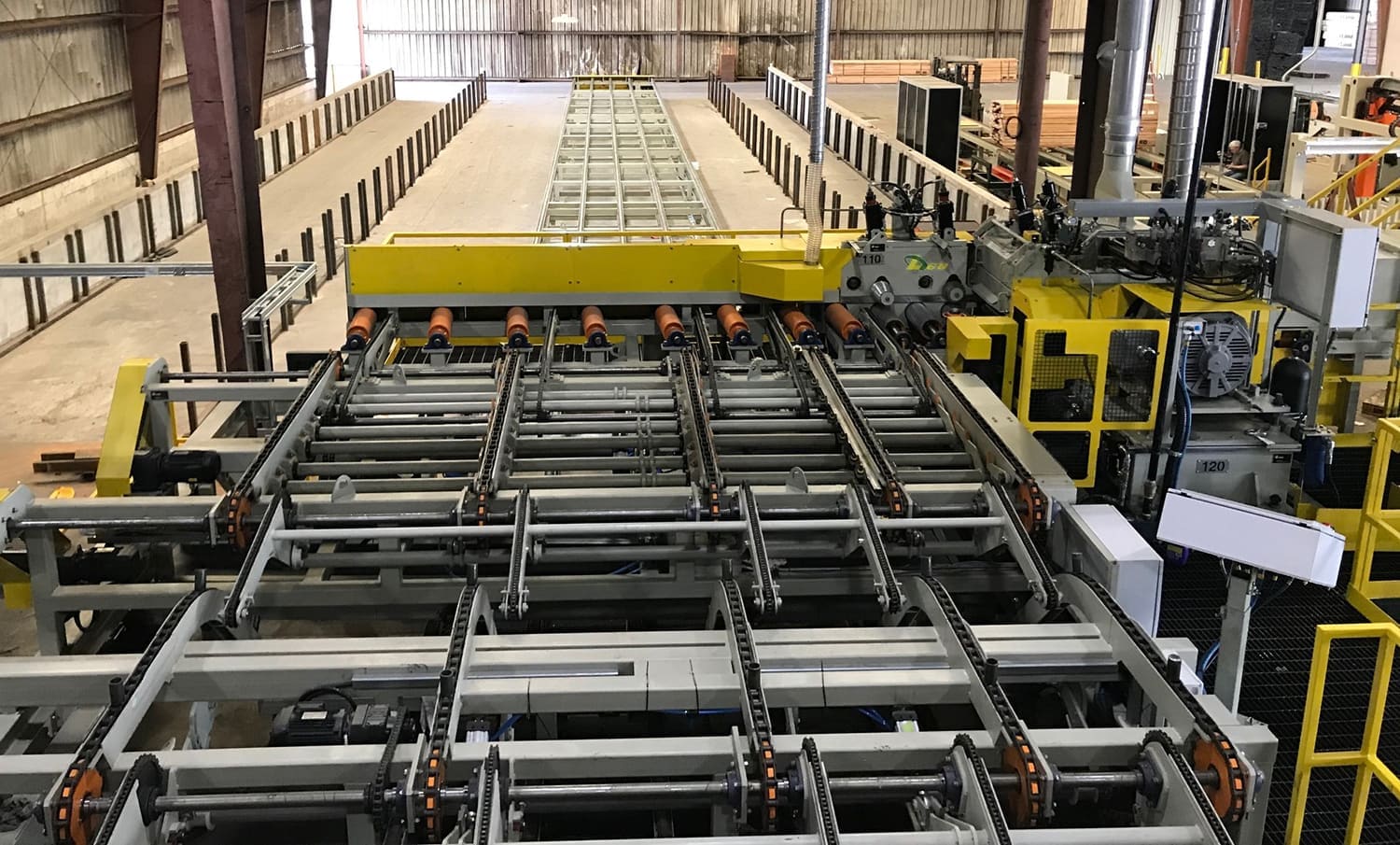
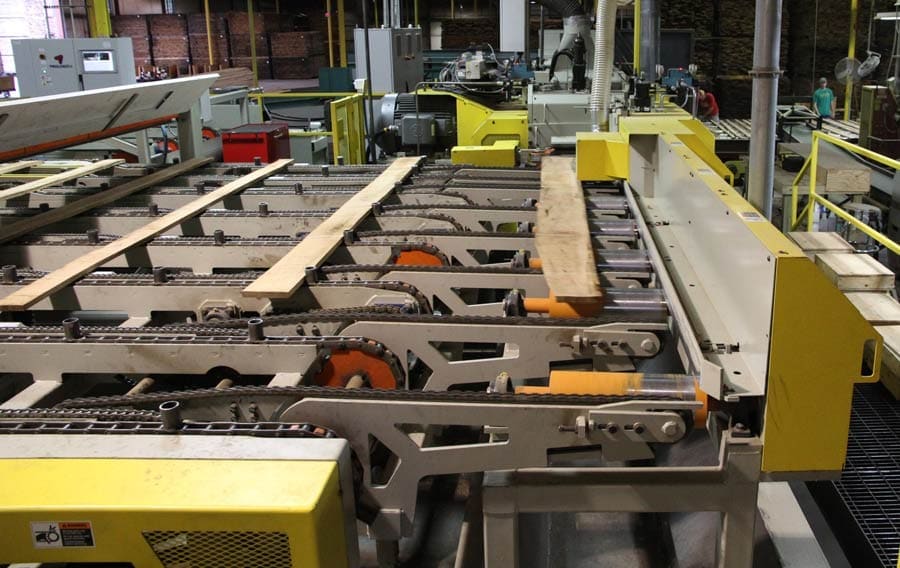
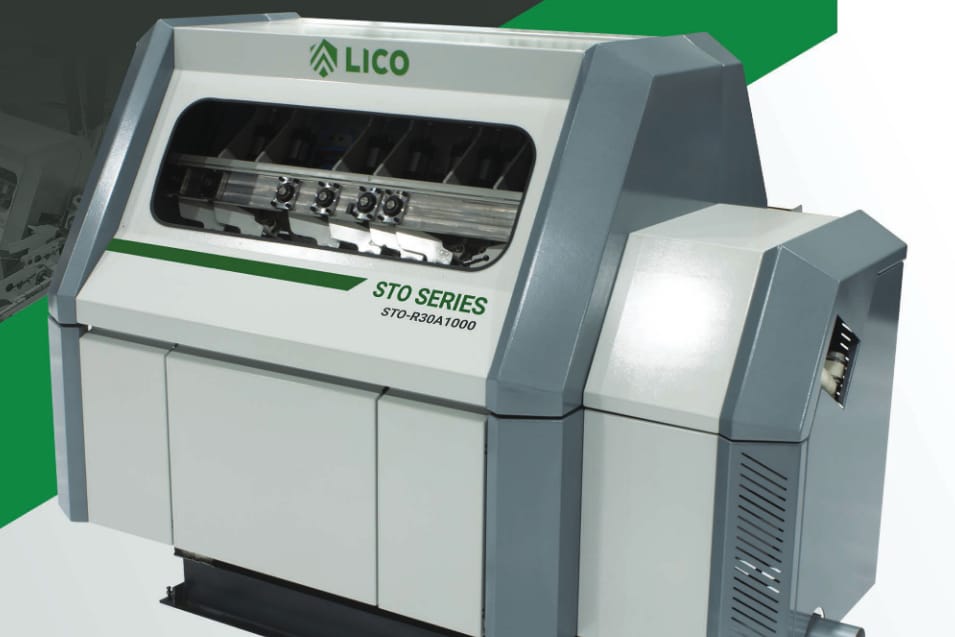
The builder's own engineering
We are the manufacturer's own U.S. representative, so the engineering answers come from the people who build the machine and you reach them through one number.

EBI Electric builds optical scanning and grading systems for the wood industry: the Inspector B hardwood grading scanner with cross-cut optimization, the Inspector E end-board scanner, and a full family of specialty scanners.
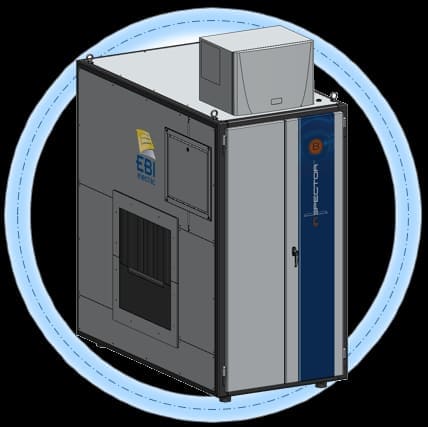
Manual grading is a judgment call made at line speed, and the published record on how well it goes is uncomfortable. Reviewing the studies, researchers at Purdue University report that the average accuracy of a human lumber inspector runs as low as 48 percent and as high as 75 percent, with production line speed, the mental arithmetic of calculating cuttings, working conditions and fatigue from repetitive work all pulling it down. Set that against the NHLA Sales Code, which calls for a minimum of 80 percent accuracy, and the gap is the reason scanning exists at all.
Worth being precise about what this does and does not say. It is not a claim that your graders are poor. It is a claim that a person doing subjective classification for eight hours performs like a person, and that a mill's tally reflects that. An earlier Forest Service evaluation found company line graders overestimating lumber value by close to 20 percent against an NHLA-certified inspection, while the automated system came within 5 percent. Overestimating is the expensive direction, because you sell against a tally that was never there.
Scanning gets described as cameras, which undersells it and hides why the good systems cost what they do. Four sensor types do different jobs, and the value is in the overlap.
Color cameras are the primary sensor. Thresholds separate clear wood from knots, stains and other defects by contrast. They also faithfully report a bootprint, a dirt smudge or a conveyor mark, which is the whole problem with color alone.
Lasers with scatter cameras solve that. Laser light refracts against the wood cells, and the shape of the scatter shows which way the grain runs, so the system can map fiber deviation around a knot. Grain deviates around a knot. It does not deviate around a bootprint. Combining the two sensors is what lets the machine throw the bootprint away, and it is the single clearest reason multi-sensor beats vision alone.
A 3D profile camera reads the shape of the board, locates wane, and confirms cracks and holes that a straight-down camera view can misread.
X-ray maps density. A knot is denser than clear wood; a hole has almost none. Thresholds are set per defect on each sensor and the sensor data is overlapped, so false defects filter out and only the genuine ones get classified.
The strongest public validation of hardwood scanning is a 2018 Purdue study published in Computers and Electronics in Agriculture. It ran 9,454 boards, 39,894 board feet, across nine commercially important hardwood species through a Microtec Goldeneye 300 multi-sensor scanner at 980 lineal feet per minute, with results verified by an NHLA-trained inspector. Across the whole volume the system came out 99.50 percent on-value and 92.22 percent on-grade.
The two figures are different measurements and the difference is the interesting part. On-grade asks whether the board landed in the correct NHLA bucket. On-value asks whether the package came out worth what it should. A scanner can put a board one grade off and still price the package correctly, and value is what you are paid on. The on-grade figure also cleared the NHLA Sales Code's 80 percent minimum, which the published human-grader range does not.
That study tested Microtec equipment, not EBI's. We are citing it because it is the only independent, peer-reviewed validation of this technology at production scale that anyone can go and read, and because it describes what the sensor class does rather than what any one vendor says about itself. EBI does not publish comparable third-party validation. Very few scanner builders do.
The study is equally useful for its limits. It could not calibrate satisfactorily for black walnut, because in walnut the clear wood and the large knots are close in both color and density, which takes away the two strongest signals at the same time. Severe iron stain in white oak needed the grading solution adjusted, and the authors note that some mills see iron stain, some never do, and some see it seasonally. If you run walnut, or you have an iron stain problem, that belongs in the scoping conversation.
One sizing note from the same work, because it answers the question buyers ask first: the authors calculated 980 lineal feet per minute as sufficient for a sawmill producing roughly 20 to 25 million board feet a year, and found that where throughput or material flow calls for a transverse-feed machine instead, the transverse equivalent produced the same results. Feed direction is a plant layout decision, not an accuracy one.
EBI codes the range by position in the line. Inspector B is the linear machine ahead of the side matcher, running rip, cross-cutting and NHLA grade optimization, scanning 1, 2 or 4 faces with color or 3D cameras. Inspector A takes the position after the side matcher, and Inspector T is the transversal machine. Inspector E handles end-board defect detection with high-frequency inspection, and Inspector F is the finishing scanner, reading stain, varnish and color on a finished surface. Inspector P covers profile and board precision tracking, Inspector R reads I.D. for product conformity, and Inspector S detects species, which is how you keep one species out of another's production lot.
Across the family the optimization modes are cross-cutting, rip, NHLA grade and sorting, and EBI lists its current development work as rot detection, heat traces, color variation control and continuous training of the classification models.
EBI Electric is a third-generation family business, in industrial electrical products since 1946 and in wood-industry scanning since 2005. They also build kiln duty motors and thousands of control panels a year, which is worth knowing if the project needs more than a scanner. Their optimizers already run inline with Lico equipment in plants we serve, so a scanning retrofit or a fully scanned line is quoted as a single integrated project.
| Inspector B | Hardwood grading scanner with cross-cut optimization |
|---|---|
| Inspector E | End-match scanner |
| Rough wood | Rough wood scanning and optimization |
| Square boards | Square board scanning and optimization |
| Moulded boards | Moulded board scanning and optimization |
| Specialty | Engineered wood lamella scanner, 4 faces scanner, end defect scanner, squaring scanner |
| Company | EBI Electric, third generation family-owned, industrial electrical products and services since 1946 |
| Wood-industry scanning since | 2005 |
| Scanner families | Inspector B for hardwood grading and cross-cutting optimization; Inspector E for end matching |
| Scanner types | Rough wood, square board, moulded board, engineered wood lamella, 4 faces, end defect, squaring |
| Process coverage | Rough lumber through moulded boards to panels on a finish line |
| Control | Dimensional, appearance and defecting control plus production yield optimization |
| Detection strengths | Color sorting, splits and shake detection |
| Primary market | Hardwood flooring, hardwood components and moulding lines |
| Other EBI products | EBI Dry Kiln Duty Motors wood dryer motors; thousands of industrial control panels built each year |
| Rework handling | End defect scanner routes non conform pieces to a rework station |
Specifications vary by configuration. Every line is engineered to the mill, so request numbers for your application.
Mills rarely buy one machine. These are the systems that most often go in with a optimized grading & scanning, and quoting them together is how the handoffs get engineered before anyone orders steel.
We are the manufacturer's own U.S. representative, so the engineering answers come from the people who build the machine and you reach them through one number.
We quote and support installations across the United States, from the Southeast to the Pacific Northwest.
Ripping, edging, scanning, sorting, stacking and waste handling on one quote, with the handoffs between them worked out before you order.
It is EBI's linear scanner for hardwood, placed ahead of the side matcher, running rip, cross-cutting and NHLA grade optimization. EBI specifies it scanning 1, 2 or 4 faces with color or 3D cameras, detecting both color characteristics and physical defects.
Inspector A sits after the side matcher, Inspector T is the transversal machine, Inspector E does end-board defect detection with high-frequency inspection, Inspector F is the finishing scanner reading stain, varnish and color, Inspector P handles profile and board precision tracking, Inspector R does I.D. readings for product conformity, and Inspector S is the species detector for controlling species within a single production lot.
It is a material-flow and throughput decision rather than an accuracy one. Longitudinal-feed machines suit a line where boards already travel end-on; transverse feed suits higher throughput or a layout that presents boards sideways. The published validation work found the same grading results either way, so choose on how your plant moves wood.
The best independent figure in the public record comes from a Purdue University validation of a Microtec multi-sensor scanner: 99.50 percent on-value and 92.22 percent on-grade across 9,454 boards of nine hardwood species. That is not EBI hardware, and we would rather cite a study you can read than a number a brochure asserts. EBI does not publish equivalent third-party validation, and nor do most scanner builders.
Yes. The same Purdue study could not calibrate its scanner satisfactorily for black walnut, because clear wood and large knots in walnut are close in both color and density, which weakens the two strongest sensors at once. Severe iron stain in white oak also needed the grading solution adjusted. If you run either, raise it during scoping. Do not assume it is handled.
Yes. EBI optimizers run on Lico lines in production plants today, including optimizer installations after the moulder, and we represent both brands so integration is quoted as one project.
Sizing, options, budget numbers and lead times, in one conversation.