The builder's own engineering
We are the manufacturer's own U.S. representative, so the engineering answers come from the people who build the machine and you reach them through one number.

EBI Electric has been an industrial electrical manufacturer since 1946 and has built optical scanning for the wood industry since 2005. Their scanners are the eyes on a grading line: they read the board and tell the saws where the value is. They also build the kiln duty motors and control panels most mills buy from somebody else.
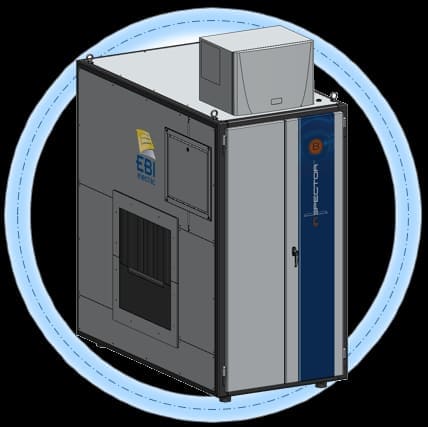
EBI Electric describes itself as an industrial electrical business since 1946, with over seventy five years behind it. Optical wood scanning came later, in 2005, and it grew out of what the company already was rather than arriving as a new venture: motor control, high-temperature motors and custom control panels are all still core products.
That history is the reason to take the scanners seriously. A scanner is a camera and a computer bolted to a machine that has to survive a sawmill, and the surviving part is an electrical and controls problem before it is an imaging one.
A board arriving at a rip line is not uniform. It has knots, splits, wane and color variation, and the value locked in it depends entirely on where you choose to cut. A scanner reads the piece and hands the machine a solution: this many strips, at these widths, avoiding those defects.
Scanning levels run from single-point through to full 3D depending on how much geometry and defect information you want driving that decision. More information is not automatically better, it is better up to the point where the machine downstream can act on it, which is why the scanner and the saw get specified together.
On the numbers: comparative accuracy figures do exist for scanning hardware, and where we publish them we do it on the product page with the study and the hardware named. They are not the kind of claim that should float free on a brand page.
Kiln duty motors are a genuinely awkward purchase. They live in a hot, wet, corrosive box for their entire service life, and a general-purpose motor put in that position fails early and takes the kiln offline when it goes.
EBI builds motors specifically for that duty, and industrial control panels alongside them. If you are already talking to us about a scanner, these are worth asking about in the same conversation, because they are on your maintenance budget either way.
We quote and support EBI equipment in the United States with the builder's own engineering behind it. Because the scanner almost always arrives alongside a saw, the useful first conversation is about the whole station rather than the scanner alone: what you run, what the machine downstream can do with a solution, and what you want the line to stop doing.
| Product | What it does | Where it sits |
|---|---|---|
| Inspector Series scanners | Optical grading and defect detection | Ahead of the saws on a grading line |
| End-match scanning | Reads the ends for match and defect | On the end-match line |
| Crosscut optimization | Decides the cut solution by value | Driving an optimized crosscut saw |
| Kiln duty motors | High-temperature motors built for kiln service | Inside the kilns |
| Industrial control panels | Custom motor control and panel build | Anywhere in the plant |
Configurations vary by mill. Ask which one fits your line.
An optimized line is really two things: a machine that can cut anywhere, and something that knows where to cut. EBI supplies the second half. Without it a rip or crosscut line runs the setting it was given, which is the difference between recovering the value in a board and averaging it away.
An EBI optimizer running on Lico equipment is a normal configuration in the plants we serve, and Lico lists EBI among its own supplier partners. That pairing is the single most common thing we are asked to quote, which is why we would rather scope the scanner and the saws in one conversation than have them arrive from two vendors and meet for the first time on your floor.
The part most mills miss is the rest of the catalog. The company that can build your grading scanner also builds kiln duty motors and control panels, and those are things you are already buying.
We are the manufacturer's own U.S. representative, so the engineering answers come from the people who build the machine and you reach them through one number.
We quote and support installations across the United States, from the Southeast to the Pacific Northwest.
Ripping, edging, scanning, sorting, stacking and waste handling on one quote, with the handoffs between them worked out before you order.
Yes, and that is a common project. Adding scanning to an existing rip or crosscut line is usually a far smaller job than replacing the saws, and it is where the recovery gain comes from. What matters is whether the machine downstream can act on a solution once it has one.
No, and this is worth knowing. EBI has been an industrial electrical manufacturer since 1946 and entered wood scanning in 2005. They also build high-temperature kiln duty motors and industrial control panels, which most mills currently source somewhere else.
Grading, ripping, crosscutting and sorting solutions, depending on the configuration and what the machine downstream can act on. The right answer depends on your product mix, so it is a scoping question rather than a catalog one.
We quote and support EBI scanning in the United States, with the builder's own engineering behind the quote. Call Mike Rose on 615-948-9983.
Four builders, one contact. Each line picks up where the last leaves off, and most mills end up specifying two of them together.
Sizing, options, budget numbers and lead times, in one conversation.