The builder's own engineering
We are the manufacturer's own U.S. representative, so the engineering answers come from the people who build the machine and you reach them through one number.

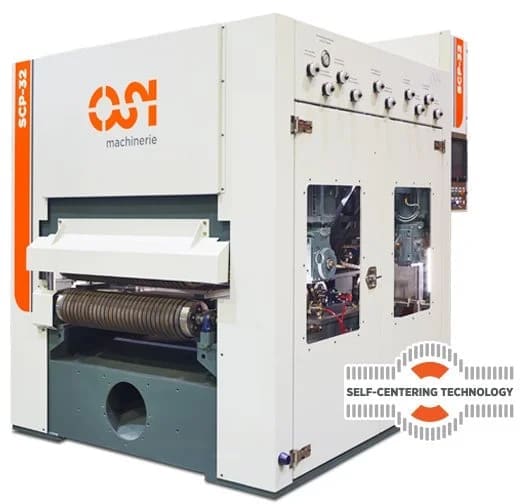
OSI SCP Series self-centering planers reference each piece on its own centerline and take material off both faces, holding thickness to plus or minus 0.003 inch. Models run 18 to 32 inches wide at feeds to 350 feet per minute.
A conventional planer references one face. Every bit of thickness variation in the rough board therefore comes off the opposite face, which is fine on flat stock and expensive on stock that is cupped, bowed or simply sawn inconsistently. The high side gets planed through and the low side keeps its skip.
The SCP centers each piece as it feeds, using the feed rolls together with segmented pressure fingers on independent suspension, and cuts with vertically opposed heads above and below. The variation splits across two faces instead of stacking on one, and OSI guarantees the result to plus or minus 0.003 inch. Four models cover 18 to 32 inches of working width, at feeds up to 350 feet per minute.
OSI makes three specific claims about where the machine belongs, and each one is a separate argument to a different part of your operation.
Ahead of a scanner. A scanner reads a surface. A rough sawn face carries saw marks, dirt and torn grain that a color camera has to work around, and the published research on this is blunt about the consequence: benign dark marks get called as defects. Surfacing first gives the optimizer a cleaner picture to decide from. The Forest Service reached the same conclusion from the yield side, finding that presurfacing to make defects more visible before the crosscut or ripsaw raises yield and cuts the number of rejected parts.
Ahead of the kiln. This is the one mills tend not to expect. Thickness variation between boards in a package is what forces a conservative kiln schedule, because the schedule has to suit the thickest piece in the load. Even out the thickness and the load dries faster. The Forest Service dry kiln literature puts the saving at 16 to 30 percent of drying time on 4/4 northern red oak, which in kiln days is roughly 18 days green to 7 percent instead of 21 to 28. On oak, which is the slowest thing most hardwood mills run, that is kiln capacity you did not have to build.
After a ripsaw. OSI states the SCP is the only planer that can be placed there. Strips coming off a rip line are narrow, short and no longer share a common reference face, which is exactly the condition a one-face planer handles worst and a centering machine handles naturally. For a flooring plant that surfaces strips rather than boards, that is the whole argument.
The planers are the machines mills ask about first, but OSI builds the profiling end of a flooring line too. The SM-450 profiler splits moulding into stages so tenons and mortises are machined without the board's own curve and twist working against them, holding plus or minus 0.002 inch and feeding pieces as short as 9 inches, which is the shortest piece the flooring standard allows. The EM series end matchers hold squareness to plus or minus 0.001 inch per inch of board width. There is also a self-centering sander built on the same centering principle.
| Models | SCP-18, SCPs-18, SCP-24 and SCP-32 |
|---|---|
| Working width | 18 in to 32 in, depending on model |
| Guaranteed thickness precision | Plus or minus 0.003 in (0.076 mm) |
| Feed speed, SCP-18 | Up to 350 ft/min |
| Feed speed, SCP-24 | 100 to 350 ft/min |
| Feed speed, SCP-32 | 160 to 350 ft/min |
| Feed speed, SCPs-18 | Up to 100 ft/min |
| Cutterhead arrangement | Vertically opposed, removing equal material from the top and bottom face |
| Centering | Patented automatic centering by the feed rolls and segmented pressure fingers, independently suspended so each piece is centered on its own |
| Placement, before a scanner | OSI states the planer is extremely effective ahead of a scanner, because a clean surface is an easier surface to read |
| Placement, after a ripsaw | OSI states the SCP is the only planer that can be placed after a ripsaw |
| Placement, before drying | Presurfacing improves drying uniformity |
| Applications | Hardwood flooring and dimension stock |
| Wider OSI range | Self-centering planers, self-centering sander, SM-450 profiler (plus or minus 0.002 in, feeds pieces down to 9 in), EM-60/EM-95/EM-135 end matchers (plus or minus 0.001 in per inch of board width) |
| Experience | More than 30 years designing and manufacturing wood processing equipment |
Specifications vary by configuration. Every line is engineered to the mill, so request numbers for your application.
Mills rarely buy one machine. These are the systems that most often go in with a optimized self-centering planers, and quoting them together is how the handoffs get engineered before anyone orders steel.
We are the manufacturer's own U.S. representative, so the engineering answers come from the people who build the machine and you reach them through one number.
We quote and support installations across the United States, from the Southeast to the Pacific Northwest.
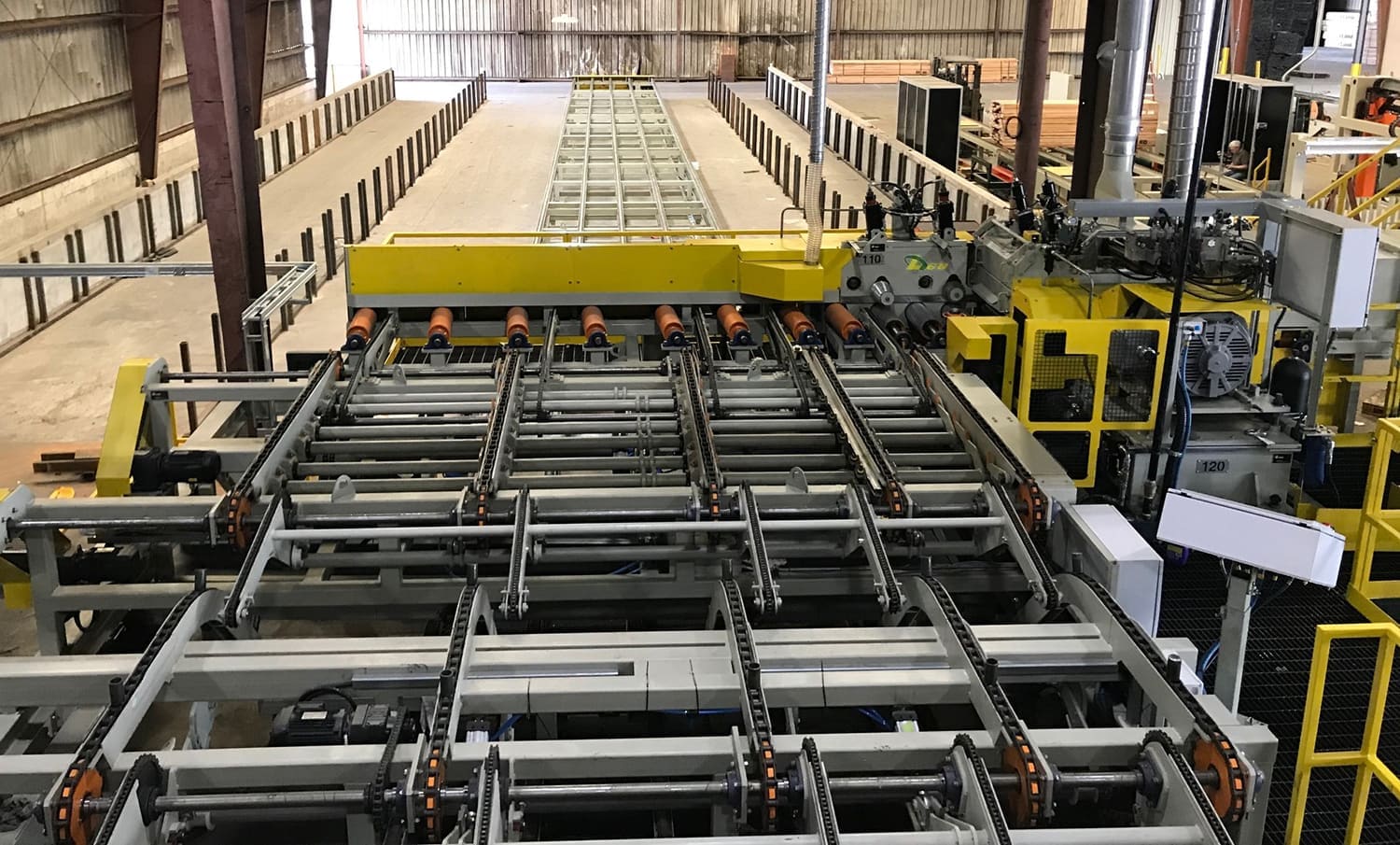
Ripping, edging, scanning, sorting, stacking and waste handling on one quote, with the handoffs between them worked out before you order.
Instead of referencing one face and pushing all the thickness variation to the other side, the SCP centers each piece by the feed rolls and segmented pressure fingers, then removes the same amount from the top and bottom with vertically opposed cutterheads. The fingers are independently suspended, so each piece is centered on its own rather than on the last one.
A cupped or bowed board referenced off one face gets planed through on the high side and left with skip on the low side. Centering splits the variation across two faces, so the machine removes the minimum needed to clean both, more boards make target thickness on the first pass, and fewer come out scant.
Three places, and OSI is specific about all three. Ahead of a scanner, because a surfaced board is an easier board to read. Ahead of drying, because uniform thickness dries more evenly. And after a ripsaw, which OSI says no other planer can do.
SCP-18, SCPs-18, SCP-24 and SCP-32, covering 18 to 32 inches of working width. Feeds run to 350 feet per minute on the SCP-18, SCP-24 and SCP-32, and to 100 feet per minute on the SCPs-18. All hold plus or minus 0.003 inch.
Yes, the SCP videos are on this page, including a customer testimonial from Baird Brothers, and we can arrange a deeper technical walkthrough with OSI.
Sizing, options, budget numbers and lead times, in one conversation.