The builder's own engineering
We are the manufacturer's own U.S. representative, so the engineering answers come from the people who build the machine and you reach them through one number.

The Lico oscillating table moves slabs from carriages and edgings from edgers to the primary waste conveyor. It solves lateral waste transfer with less noise and less maintenance than a vibrating conveyor.
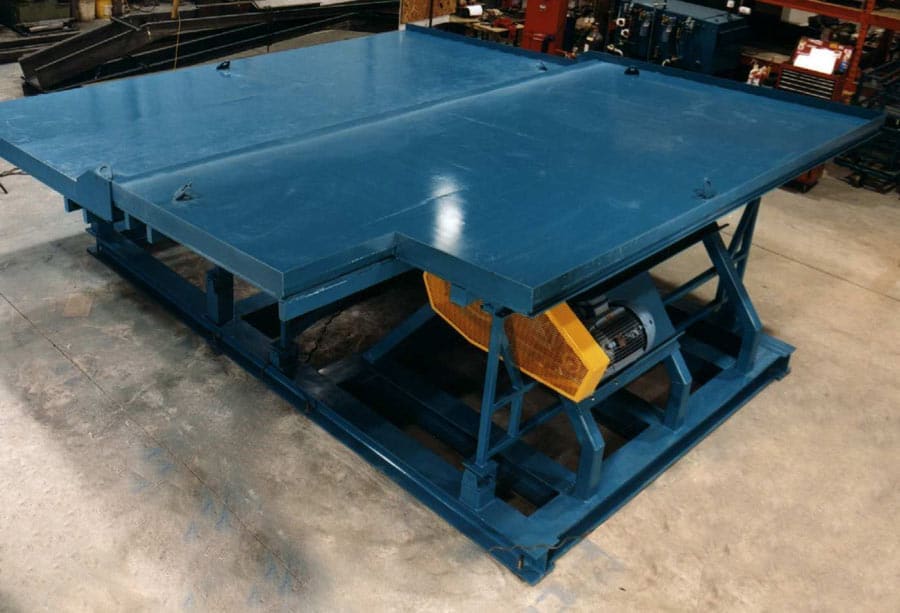
Slabs come off the carriage and edgings come off the edger, and both usually need to travel sideways before they reach the mill's primary waste conveyor, which is generally running on a different axis. Something has to make that move, continuously, for as long as the saws are cutting. The oscillating table does it with an oscillating motion rather than by throwing the material, and Lico's case for it on this duty is that it runs quieter and needs less maintenance than putting a vibrating conveyor on the same job.
This is a small machine by Lico standards and it is rarely on anybody's list at the start. It tends to enter the conversation at the layout drawing, when a new edger or gang has been specified and the residue side of the plan turns out to have nowhere to put what the new machine will produce. When the waste path backs up, the saw stops, so the transfer is production equipment even though it never touches a product.
Noise in a sawmill is a regulated exposure. OSHA requires a continuing, effective hearing conservation program wherever employee noise exposure reaches an 8-hour time-weighted average of 85 dBA [1910.95(c)(1)], and feasible engineering or administrative controls must be used where exposure exceeds the levels in Table G-16 [1910.95(b)(1)]. In its own sawmill guidance OSHA is specific about the hierarchy: the preferred method of engineering control is noise reduction at the source, and engineering controls are the best long-term solution to occupational noise.
Choosing a quieter machine for a duty that runs the whole shift is noise reduction at the source, in OSHA's own terms. That is worth weighing at the layout stage, when it costs a specification decision. After commissioning the same problem costs enclosures and a monitoring program.
The honest limit on that argument: Lico publishes no decibel figure for the table, and the vibrating conveyors it would replace generally do not publish one either, so the comparison rests on design intent and nobody has measured it. We are not going to hand you a number nobody measured. If noise is the reason you are looking, ask and we will chase a sound measurement from an installed machine before you commit to anything.
There are no standard sizes. Lengths and widths are engineered per installation to match the transfer the layout actually requires, which means this is quoted from your drawing. There is no model list to pick from. It is a common addition alongside an edger or gang purchase, and the sensible time to raise it is while the rest of the layout is still on paper.
| Function | Moves slabs from carriages and edgings from edgers to the primary vibrating waste conveyor |
|---|---|
| Problem solved | Lateral-transfer waste removal |
| Sizing | Various lengths and widths |
| Noise | Quieter than vibrating conveyors |
| Maintenance | Low maintenance design |
Specifications vary by configuration. Every line is engineered to the mill, so request numbers for your application.
Mills rarely buy one machine. These are the systems that most often go in with a optimized oscillating table, and quoting them together is how the handoffs get engineered before anyone orders steel.
We are the manufacturer's own U.S. representative, so the engineering answers come from the people who build the machine and you reach them through one number.
We quote and support installations across the United States, from the Southeast to the Pacific Northwest.
Ripping, edging, scanning, sorting, stacking and waste handling on one quote, with the handoffs between them worked out before you order.
Anywhere waste needs to move sideways to reach the primary vibrating waste conveyor: typically taking slabs off carriages and edgings off edgers. It is a green-end machine, and it usually enters the conversation when a layout drawing shows the residue having nowhere to go.
For lateral transfer duty specifically, Lico's case is that it runs quieter and needs less maintenance than putting a vibrating conveyor on the same job. It is built to the lengths and widths your layout requires. There is no catalog size.
Lico does not publish a decibel figure, and neither do the vibrating conveyors it would replace, so this is a design-intent comparison rather than a measured one. If noise is your reason for looking at it, ask us to get a sound measurement from an installed machine before you commit.
No, each table is sized to the transfer it has to make. Lengths and widths are engineered per installation, so a layout drawing is what we need to quote it.
Lico's stated case is lower maintenance than a vibrating conveyor on the same duty. No service intervals or component life figures are published, so we would get those from Lico for your configuration. We are not going to quote you a number we cannot stand behind.
Sizing, options, budget numbers and lead times, in one conversation.