Your line first
We start from what you run, the machines either side and the space you have, and work out whether this one fits before anyone talks price.

Neural Grader builds AI grading scanners for sawmills, component plants and flooring lamella producers. Each one photographs a board on 2 or 4 faces, measures it with lasers, grades it to NHLA, European or your own rules, and passes the trim, edge, rip or sort call to the machine downstream. There are three models for transversal and linear lines, and the smallest needs about 600 mm (24 in) of conveyor.
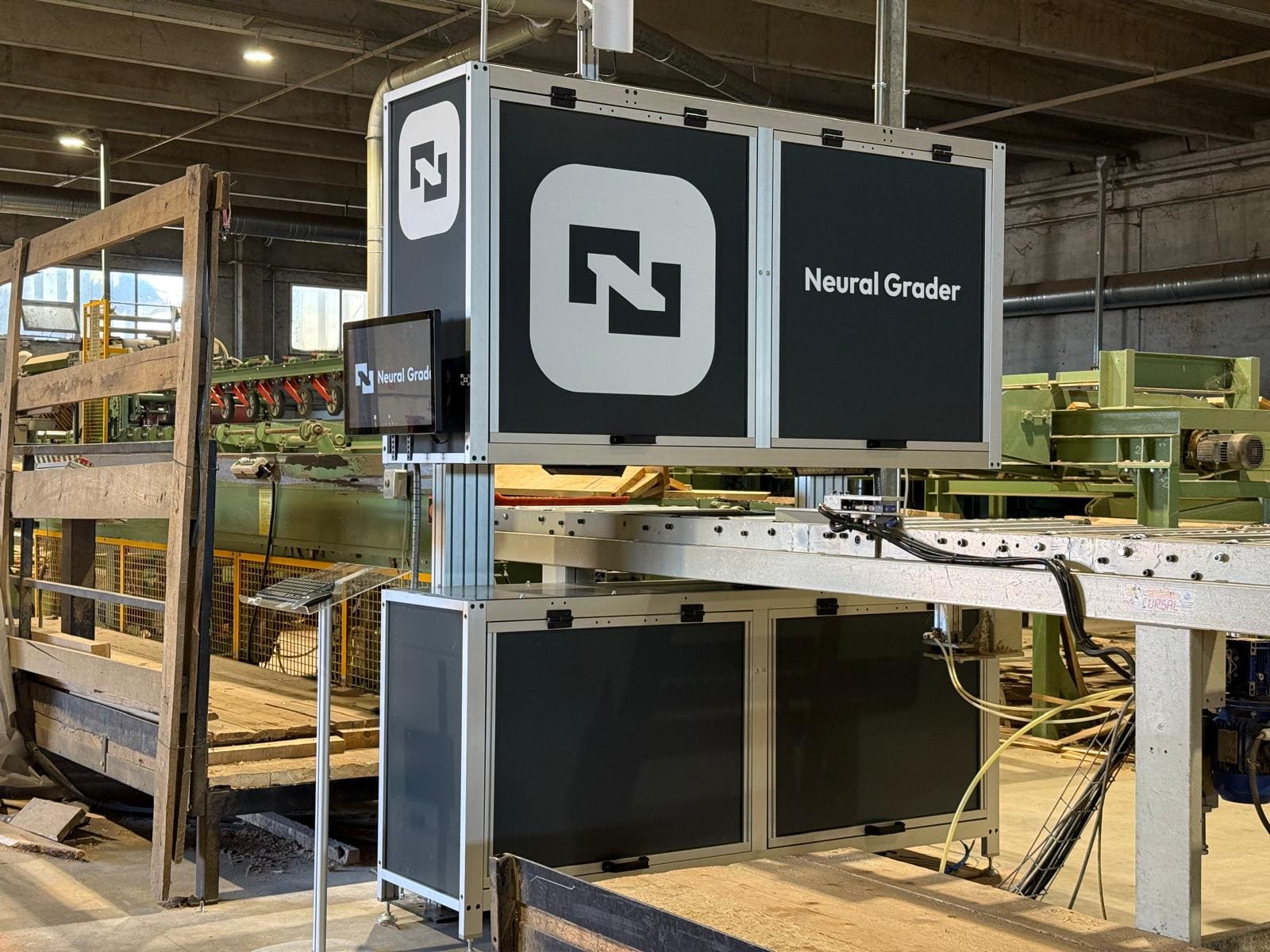
A Neural Grader scanner sits over the conveyor and reads each board as it passes. Four parts do the reading, and the software behind them turns what they find into an instruction for the machine downstream.
Industrial cameras capture each board from several angles, on 2 or 4 faces, and send high-resolution images in real time at line speed. Neural Grader says the vision system adjusts for surface texture, grain direction and board movement, on rough green or dry lumber.
Each scanner carries its own LED arrays with diffuse and directional control and a color rendering index above 90. The lighting adjusts automatically to the species and the board type, so shadows, glare and uneven light do not get read as defects.
Laser triangulation modules measure width, thickness, length and warp (bow, twist, crook and cup) to plus or minus 0.2 mm, about 0.008 in, at up to 300 boards a minute. The modules are enclosed against dust, and their measurements feed both the grading and the cutting decisions.
The images go to Neural Grader's own deep learning engine, trained on more than 100,000 boards of 15+ species from 10+ countries, and it keeps learning. It reads sound, unsound and encased knots, splits, checks and shake, pin and worm holes, pitch pockets, rot and decay, stain and discoloration, wane and bark pockets, and grain pattern and direction. Neural Grader's notes on the Compact add the color defects cameras find hard, such as heart and blue stain, and say the system ignores marks left by chains, slats and rain.
It grades to NHLA rules, European standards, JAS requirements or a customer's own rules, and can be set for species-specific criteria, a particular end use, maximum yield or sorting by value.
By Neural Grader's account every component is engineered for dusty, vibration-prone, high-throughput plants. Processing runs in real time on an industrial computer with GPU acceleration and a redundant architecture. The scanners diagnose themselves and need little from an operator, and the software is modular, with an operator interface, remote monitoring, data analytics and ERP integration.
Which model you need comes down to the conveyor: whether boards cross the scan point sideways or end-on, and how many run side by side.
For high-speed transversal lines carrying green or kiln-dried lumber. It scans geometry and appearance on 2 or 4 sides at up to 300 boards a minute, takes boards up to 1,000 mm wide (about 39 in) and needs 1,000 mm of clearance above the conveyor. The enclosure is sized to your conveyor width, and the 2 face version takes the maximum board width plus 200 mm (about 8 in) of line length.
For linear conveyors running up to 3 boards side by side. It scans 2 or 4 sides at up to 300 boards a minute in about 600 mm (24 in) of line length, which is why Neural Grader aims it at retrofits: lines where older equipment, the conveyor design or the building leave no room for a scanner. It launched in May 2025 for sawmills and component producers short on space, and in Neural Grader's words it has the same capabilities as the larger models:
It grades boules and lumber, whether unedged, edged or surfaced, and it runs on component lines with a rip saw, a crosscut or both.
For linear conveyors running more than 3 boards in parallel. It scans geometry and appearance on the top and bottom faces of up to 8 boards at once, takes boards up to 1,500 mm wide (about 59 in), needs 1,000 mm of clearance and is built to the width of your conveyor, with about 600 mm of line length.
All three connect to a trimmer, an edger, a sorting line and a printer over Ethernet, an API, a PLC or Modbus, and run on 110 to 220 V.
The scanner does the reading. The decisions come from Neural Grader's software platform, which is built from the modules below.
Thickness, width, length, bow, twist, crook and cup on every board, with out-of-tolerance flags and real-time alerts.
Sub-millimeter detection of visual defects: pith, splits, bark, sound and unsound knots, decay and rot, shake, checks, pin knots, worm holes, mineral, stain, heart, blue stain, sap, mold, wane and skip marks, along with other manufacturing errors. It is trained on the main European and North American species and works on green, kiln-dried and surfaced lumber.
NHLA, European and custom grading rules on boules, unedged and edged lumber, with a grading rules simulator for testing and tuning the rules.
For sawmills. It works out the trim and edge cuts that give each board its highest value and can run most trimming and edging operations. Instructions go straight to the machine, or to the operator where the machine is not automated.
For component producers. It works out rip and crosscut solutions for yield, takes production priorities on dimensions or other features of the parts into account, and instructs the machine or the operator the same way. These cutting lines are one of Neural Grader's main focuses for 2026, and its 4 side vision now lets a plant run variable widths within the same production batch.
Sorts by grade, length, width, thickness, species, color and grain, and works with automated sorting equipment. Neural Grader also offers it to mills with species mix-ups between batches.
Prints an ID and the grade on each board, plus anything else the customer needs on it, and works with most industrial printers. With every board numbered, a claim or a supply-chain question can be traced back to the board.
Live dashboards and historical reports on the volume and value of production by grade and species, broken down by dimension, defect type and grade, with figures per shift, order, sort and bundle down to the single board. The reports export.
Tracks boards into bundles, keeps the tally, generates and prints bundle tags and syncs with ERP or warehouse tools. Neural Grader calls the board-to-bundle tracking Smart Bundle Technology.
Neural Grader sells into four groups, and the pitch to each is a little different.
Measurement, grading, edging and trimming for North American and European hardwoods, to NHLA rules or your own. For sawmills Neural Grader aims at lower grading costs, more value per board, fewer claims, better sorts and a faster line, using deformation measurement, sub-millimeter defect detection, a grading engine for edged and unedged lumber with simulation tools, trim and rip instructions, species sorting, board IDs, bundle tallies and tags, and reporting down to the board.
Measurement, grading, edging, trimming and species sorting. Neural Grader describes this work in terms of European softwoods and said in May 2026 that it was now also taking on softwood customers, so on a North American softwood line, ask for specifics on your species.
Running the rip saw and crosscut lines, with the aim of lower labor cost, higher yield, fewer quality problems and a faster line. Detection covers shake, worm holes, pin knots, stain, rot and heart on rough green and dry hardwood and softwood, and boards are tracked into bundles.
A lamella grading engine built for multilayer solid wood flooring, with rip and crosscut optimization and each lamella tracked into its bundle. On an engineered flooring line, this is the use case to ask about.
Neural Grader puts the benefits under four headings: consistent grading, and so fewer claims; throughput of up to 300 boards a minute with several boards handled at once; less dependence on skilled graders, who are hard to find; and more value per board from optimized yield and cuttings. It describes its mission as making the wood industry more profitable by getting more revenue out of the same wood, and it treats the installation as the first step of the work with a customer.
None of that comes with a published yield or payback figure. Ask for numbers from a line like yours before building a case on them.
The scanners are built as modules, which according to Neural Grader is what gets installation on most existing production lines down to about four days; its use-case pages put it at 3 to 4. For the Compact it gives 4 days in total with the line stopped for 1 of them, and a single day down can go on a weekend. The Compact arrives ready to run and takes remote updates. Neural Grader publishes no prices.
On space, the Transversal needs the board width plus 200 mm of line length and the two linear models about 600 mm. The Compact took 550 mm at Pomeranian Timber.
Neural Grader has published the line details for its installation at Pomeranian Timber, one of Poland's leading beech producers. A Linear Compact runs on the grading line for steamed, kiln-dried, rough unedged beech: boards of variable width up to 800 mm (about 31 in) on a roller conveyor at 1.5 m/s (about 295 ft/min), one board graded every 4 seconds. The scanner takes up 550 mm (about 22 in) of the line, and Neural Grader added vibration-correction software for the roller conveyor.
It is a hard job for a camera. Steaming leaves color gradients that can hide a defect or invent one, and red heart, the defect that sets the grade on that species, looks different from one board to the next. Pomeranian is also the first site running Smart Bundle Technology, which follows each board from the scanner into its bundle so the customer can trace it.
Neural Grader is part of the Fordaq group, which also runs Fordaq.com, a B2B marketplace for wood products started 25 years ago, and Tally Express, a bundle measurement app. The Nieuwenhuys brothers founded it: Benoit Nieuwenhuys is CEO and Bruno Nieuwenhuys is CTO. The chairman, Sampsa Auvinen, has more than 30 years of executive leadership in the forest industry and chairs the European Confederation of Woodworking Industries (CEI-Bois). The scanner launched at LIGNA 2025, and Neural Grader says it works with all equipment manufacturers.
Talk to Mike about Neural Grader for your line. The first conversation is about the line more than the scanner: what species and products you run, whether boards pass the scan point lengthwise or crosswise, how many run side by side, how much conveyor you can give up, and what the machines downstream can do with a solution. Neural Grader says it fits the scanning and software to the line rather than the other way round, and starts every project from the customer's line and goals. That is the right order.
The machines it hands decisions to are the same kinds this site covers: board edgers, rip lines, optimized crosscut and bin sorters. Whether a particular machine can take instructions directly is a scoping question. If you are weighing Neural Grader against the EBI Inspector range, bring that into the same call.
| Models | NG Transversal, NG Linear Compact and NG Linear XXL |
|---|---|
| NG Transversal | 2 or 4 side scanning for high-speed transversal lines, green or kiln-dried lumber, up to 300 boards per minute |
| NG Linear Compact | 2 or 4 side scanning for linear conveyors running up to 3 boards in parallel, up to 300 boards per minute |
| NG Linear XXL | 2 side (top and bottom) scanning for linear conveyors running more than 3 boards in parallel, up to 8 boards at once |
| Plant types | Hardwood and softwood sawmills; component, furniture, joinery and glued-product plants; lamella producers for multilayer flooring |
| Maximum board width | 1,000 mm (about 39 in) on the Transversal; 1,500 mm (about 59 in) on the Linear XXL |
| Clearance above the conveyor | 1,000 mm (about 39 in) |
| Line length, linear models | About 600 mm (24 in); width built to your conveyor |
| Line length, Transversal | Maximum board width plus 200 mm (about 8 in) for the 2 face enclosure |
| Cameras | 16 MP industrial cameras (5328 x 3040), multi-angle capture |
| Lighting | Tuned LED arrays, diffuse and directional control, color rendering index above 90, adjusted by species and board type |
| Geometric measurement | Laser triangulation, plus or minus 0.2 mm (about 0.008 in) on width, thickness, length, bow, twist, crook and cup; enclosed against dust |
| Defect detection | Sub-millimeter detection of knots (sound, unsound, encased, pin), pith, splits, checks, shake, worm and pin holes, pitch pockets, rot and decay, stain, blue stain, heart, mineral, sap, mold, bark, wane and skip marks |
| Lumber | Green, kiln-dried and surfaced; boules, unedged and edged |
| Grading rules | NHLA, European standards, JAS and customer-specific rules, with a grading rules simulator |
| Training data | More than 100,000 boards of 15+ species from 10+ countries, including the main North American and European species |
| Software modules | Geometric measurement, defect detection, grading, trimming and edging optimizer, components (rip and crosscut) optimizer, sorting, printing and board ID, production reporting, bundle management |
| Sorting | By grade, length, width, thickness, species, color and grain; works with automated sorters |
| Machine connections | Trimmer, edger, sorting line and printer, over Ethernet, API, PLC or Modbus |
| Where a machine is not automated | Decisions go to the operator as instructions where a machine cannot take them directly |
| Processing | Industrial computer with GPU acceleration, real-time processing, redundant architecture |
| Maintenance | Self-diagnosing with minimal operator intervention; remote monitoring; remote updates on the Compact |
| Power | 110 to 220 V |
| Installation | 3 to 4 days on an existing line, by Neural Grader's figures; 1 day of line downtime on the Compact |
| Builder | Neural Grader, part of the Fordaq group (Fordaq.com, Tally Express) |
Specifications vary by configuration. Every line is engineered to the mill, so request numbers for your application.
Mills rarely buy one machine. These are the systems that most often go in with a lumber grading scanner, and quoting them together is how the handoffs get engineered before anyone orders steel.
We start from what you run, the machines either side and the space you have, and work out whether this one fits before anyone talks price.
We quote and support installations across the United States, from the Southeast to the Pacific Northwest.
Ripping, edging, scanning, sorting, stacking and waste handling on one quote, with the handoffs between them worked out before you order.
It depends on how boards travel past the scan point. A transversal line takes the NG Transversal, which scans 2 or 4 sides at up to 300 boards a minute. A linear line running up to 3 boards side by side takes the Linear Compact, also 2 or 4 sides at up to 300 boards a minute. A linear line running more than 3 boards in parallel takes the Linear XXL, which scans top and bottom on up to 8 boards at once.
Neural Grader quotes 3 to 4 days on an existing production line. For the Linear Compact it gives 4 days in total, with 1 day of line downtime. The Compact takes remote updates once it is running.
Yes. Neural Grader lists NHLA rules, European standards, JAS requirements and customer-specific rules, and the grading module comes with a rules simulator for testing and tuning them.
Lamella producers for multilayer solid wood flooring are one of the four kinds of plant Neural Grader builds for, with a lamella grading engine, rip and crosscut optimization and each lamella tracked into its bundle.
Yes. The sorting module sorts by grade, length, width, thickness, species, color and grain, works with automated sorters, and Neural Grader offers it to mills with species mix-ups between batches.
The software sends its decisions straight to machines that can take them, over Ethernet, an API, a PLC or Modbus. Where that is not possible, it gives the operator the same decision as an instruction, so an older line still gets the grading and optimization.
Neural Grader lists green, kiln-dried and surfaced lumber, and boules, unedged and edged boards. Its published production example is rough, steamed, kiln-dried unedged beech at Pomeranian Timber in Poland, where red heart is the defect that sets the grade. Neural Grader also says the system ignores marks left by chains, slats and rain.
Neural Grader publishes plus or minus 0.2 mm (about 0.008 in) for its laser measurement and describes its defect detection as sub-millimeter. Its website does not include an independent grading-accuracy study, and we would rather send you to research you can read than put a figure here that the manufacturer has not published. The independent work on automated hardwood grading, limits included, is summarized on our EBI grading and scanning page.
Sizing, options, budget numbers and lead times, in one conversation.