The builder's own engineering
We are the manufacturer's own U.S. representative, so the engineering answers come from the people who build the machine and you reach them through one number.

The STO Series is Lico's optimized crosscut line for wood flooring plants. A servo-driven blade with a 125 millisecond stroke crosscuts boards fed at up to 1,000 feet per minute, holding a cut tolerance of 0.030 inch.
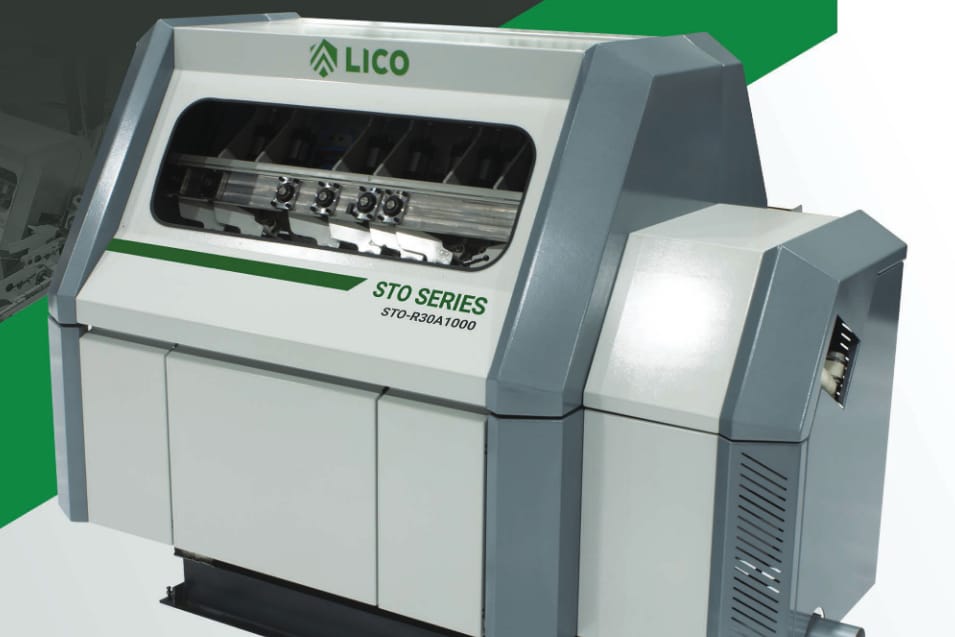
The STO takes stock from 0.8 to 8 inches wide, with a 12 inch option, and puts out pieces from 10 inches. Those numbers describe ripped strip, and Lico's brochure is direct about the intent: the series is designed specifically for the wood flooring industry. So this is a dry-end machine working downstream of the rip line, and if what you need is a green-end trimmer for lumber coming off the headrig, this is not it.
Where it sits relative to the moulder varies by plant. Some run the optimizing crosscut ahead of profiling, some run it after, and the choice comes down to where you want defect removal to happen in your process. Both are in service, so treat placement as part of the scoping. The machine does not dictate it.
The saw is a servo-driven eccentric that completes a stroke in 125 milliseconds, fed by servo rollers with pressure rollers placed to hold the workpiece through the cut, at feeds up to 1,000 feet per minute. The eccentric movement is the part worth understanding: it delivers the cut quickly with less wear on the system than the alternatives, and on a machine expected to run multiple shifts the wear rate matters as much as the stroke time.
Cut tolerance is plus or minus 0.030 inch up to 39 inches, then plus or minus 0.075 percent of cutting length beyond it. Those two rules meet cleanly, which is a sign the spec was engineered rather than assembled: 0.075 percent of 39 inches is about 0.029 inch, so the percentage picks up almost exactly where the flat figure leaves off. On a 10 foot cut it gives you roughly 0.09 inch, which is the number to check your own cut list against. The headline 0.030 covers the short cuts only.
Offcuts are the thing that stops a crosscut line, and the R30A answers it with geometry. The 30 degree cutting bed lets waste fall away inside the machine, so pieces up to 5 inches are evacuated internally without a stoppage, while the same bed keeps short good pieces supported through the cut. The R0A runs the same system on a horizontal bed, and the R30 is the compact machine for tighter spaces and lighter duty.
The 10 inch minimum outfeed is worth pairing with a standard most flooring people already work to: under the NWFA and NOFMA rules no piece of finished flooring may be shorter than 9 inches. The machine's shortest usable output sits just above that floor, which is where you want it.
The most common way to under-size a crosscut line is to size it on the lumber you would like to be running. Forest Service work on rough mills found that chop saw cuts per part run about 27 percent higher on No. 1 Common than on FAS, and about 53 percent higher on No. 2A Common. Hardwood flooring is made overwhelmingly from No. 2A Common, so a line specified against FAS numbers meets the grade you actually buy and runs out of saw.
That is a sizing question before it is a machine question, and it is the first thing worth working through together. Bring your grade mix and your cut list and we will size against those instead of against the brochure.
| Board length, infeed | 500 mm (18 in) and up |
|---|---|
| Board width | 30-203 mm (0.8-8 in); up to 300 mm (12 in) available |
| Board thickness | 12-75 mm (0.5-3 in) |
| Board length, outfeed | 250 mm (10 in) and up |
| Maximum waste length evacuated in the machine | 250 mm (5 in) |
| Cross-cut tolerance (up to 39 in) | +/- 0.75 mm (0.030 in) |
| Cross-cut tolerance (over 39 in) | +/- 0.075% of cutting length |
| Saw blade stroke | Servo-driven eccentric system, 125 ms stroke time |
| Feed | Servo-driven, up to 304,800 mm/min (1,000 ft/min) |
| Cutting bed | 30 degrees (R30A); horizontal bed on R0A |
| Models | R30A1000, R0A (horizontal bed), R30 (compact) |
Specifications vary by configuration. Every line is engineered to the mill, so request numbers for your application.
Mills rarely buy one machine. These are the systems that most often go in with a optimized scan & crosscut, and quoting them together is how the handoffs get engineered before anyone orders steel.
We are the manufacturer's own U.S. representative, so the engineering answers come from the people who build the machine and you reach them through one number.
We quote and support installations across the United States, from the Southeast to the Pacific Northwest.
Ripping, edging, scanning, sorting, stacking and waste handling on one quote, with the handoffs between them worked out before you order.
The R30A1000 uses a 30 degree cutting bed that evacuates waste inside the machine and minimizes blockages. The R0A offers the same system with a horizontal bed, and the compact R30 suits tighter spaces and lighter duty. We help you match the model to your line during scoping.
No, and the capacity settles it. The STO takes stock 0.8 to 8 inches wide, with a 12 inch option, which is ripped strip rather than green lumber. Lico's own literature says the series is designed specifically for the wood flooring industry. If you are looking for a green-end trimmer, this is the wrong machine and we would rather tell you now.
On the dry end, downstream of the rip line, working on strips. Plants put the optimizing crosscut either before or after the moulder depending on where they want defect removal to happen, and both placements are in service. Where it goes in your plant is a scoping question, not a fixed answer.
Infeed boards from 18 inches long, 0.8 to 8 inches wide (12 inch option available), and 0.5 to 3 inches thick. Outfeed pieces run from 10 inches, and the machine evacuates waste pieces up to 5 inches internally.
Plus or minus 0.030 inch on cuts up to 39 inches, and plus or minus 0.075 percent of cutting length beyond that. On a 10 foot cut the percentage rule works out to about 0.09 inch.
Lico publishes stroke time and feed speed but no piece rate, because throughput depends on your piece lengths and how many cuts each piece takes. Anyone quoting you a pieces-per-minute figure for this machine without seeing your cut list is estimating.
The STO Series brochure with complete technical data is available right on this page as a PDF download, and we are glad to walk through it with you on a call.
Sizing, options, budget numbers and lead times, in one conversation.