The builder's own engineering
We are the manufacturer's own U.S. representative, so the engineering answers come from the people who build the machine and you reach them through one number.

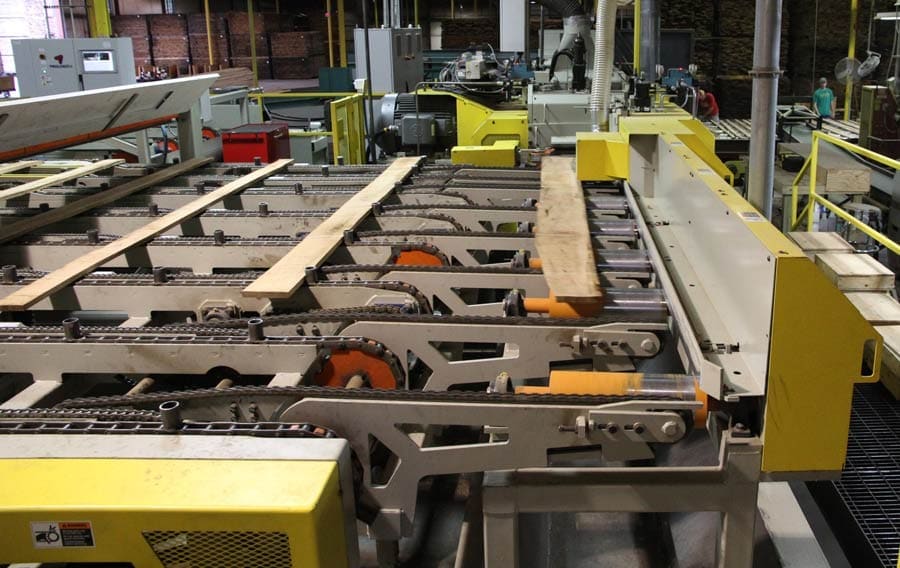
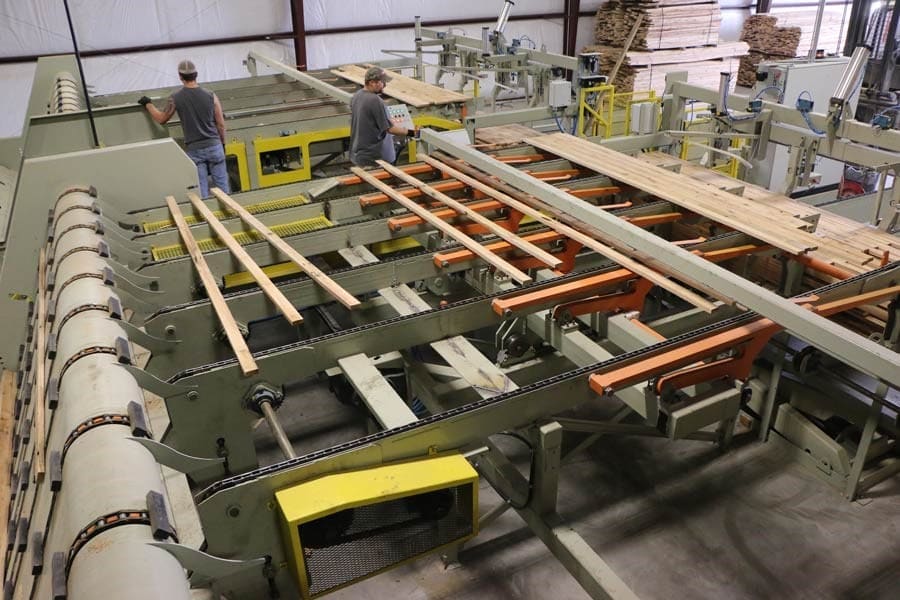
A Lico merchandising line grades and breaks down every board for maximum dollar value, not just maximum volume. The line scans each board and computes the highest-value combination it can cut, using a high-speed ripsaw with up to 5 moving blades.
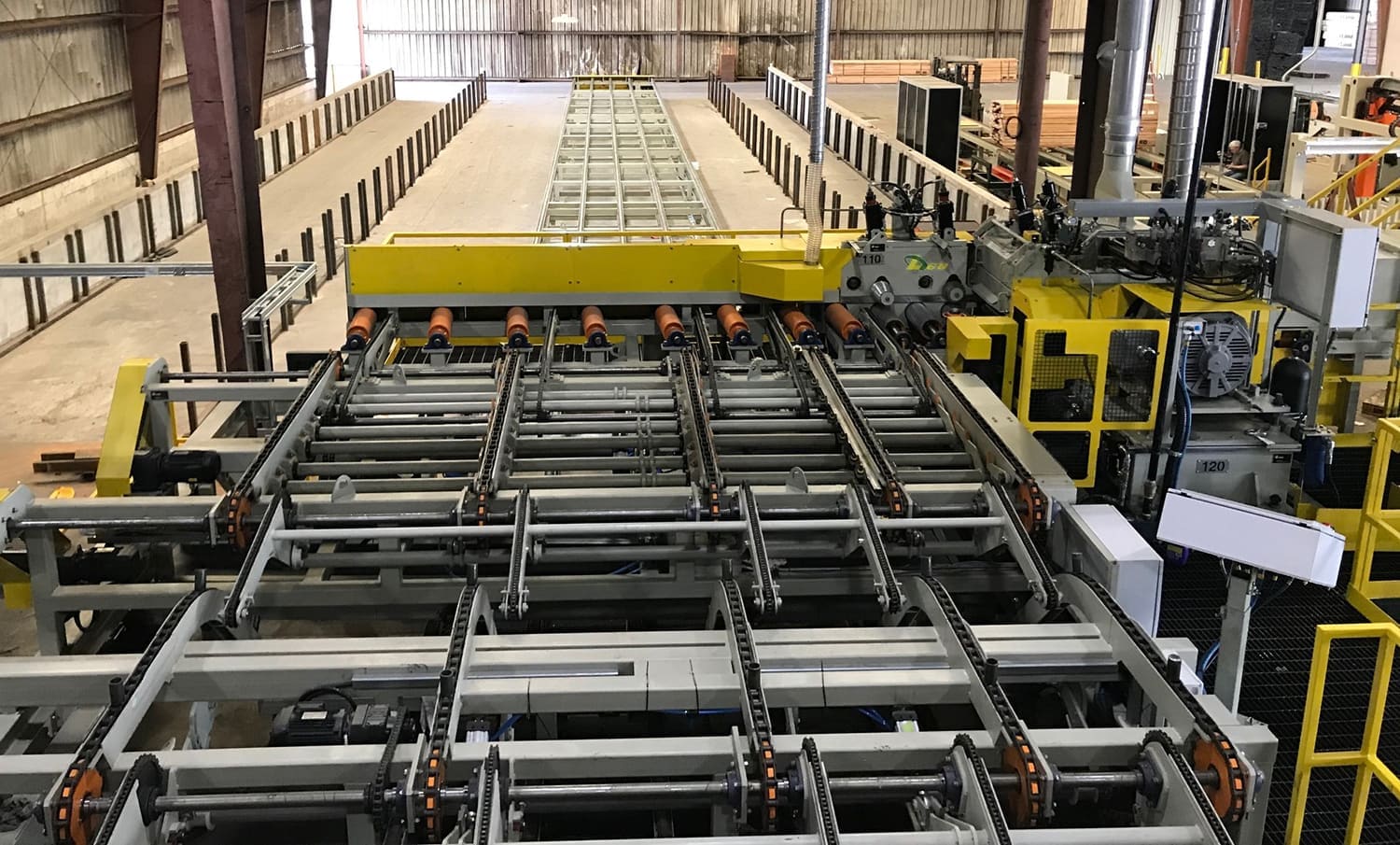
Merchandising means two different things in this industry and the gap between them is the whole width of a sawmill. To a sawmill owner a merchandiser is a log yard machine that bucks tree-length stems into log lengths. Lico's merchandising system is a dry-end lumber cut-up and grading line, which is why their own web address for it reads as a grading system rather than a merchandiser. Everything below is about the second one.
Each board is scanned on entry, the optimizer prices every viable cut combination against your product values, and the ripsaw executes that solution with up to 5 servo-positioned moving blades producing up to 4 fixed-width pieces per board. Scanning runs from single-point up to full 3D depending on how much geometry and defect data you want feeding the decision.
Around the saw the line integrates steps that usually live in separate cells: a lumber breakdown system, a grading zone, a lug loader, grade-mark reading, moisture detection, trimming and bow busting, ink marking or printing, automatic rip edging removal, top and bottom planing, then sorting and stacking, with a low-RPM grinder handling waste at the source. Output can leave as rough lumber, trimmed one or two ends, planed, ripped one or both edges to random width, or ripped to preset fixed widths, board by board.
Here is the part that gets skipped in every demo. Lico's published method is that each output product is allowed certain characteristics, grade, color and dimension, and is then assigned a dollar value per board foot, and the control system optimizes for maximum overall dollar value against that. Which means the optimizer is arithmetic, and the arithmetic is only as current as the prices you loaded into it.
A line with a stale value table will cut yesterday's best answer confidently, all shift, and every piece of the machine will be working perfectly while it does. Whoever owns the order file needs to own that table, and it wants reviewing on the same rhythm as your pricing. Set once at commissioning and left alone, it quietly leaks the return away. That is the part of this purchase that is a business process rather than a machine, and it is where the return actually lives.
Grading rewards this kind of decision because NHLA grades are yield thresholds, not opinions about appearance. The American Hardwood Export Council puts it plainly in its grading guide: the grade name designates the percentage of clear wood in the board, which is a different thing from how the board looks. A board is FAS when it yields 83-1/3 percent clear cuttings, No. 1 Common at 66-2/3 percent, No. 2A Common from 50 percent up to where No. 1 Common begins.
Those are step changes. A board a fraction under a threshold is worth what the lower grade is worth, and where you cut decides which side of the line it lands on. A grading line is making that call on every board at line speed, against your prices, which is a different job from cutting the most footage out of the piece.
Lico builds the sorting and stacking behind the line, and EBI supplies the scanning layer on plenty of these installations, so we can quote the grading zone, the saw and what happens downstream of it together.
| Core machine | Lico high-speed moving-blade ripsaw, up to 5 blades |
|---|---|
| Output | Up to 4 fixed-width pieces per board |
| Optimization | Scans each board and computes the highest-dollar output combination |
| Scanning | Single-point to full 3D |
| Waste handling | Integrated low-RPM grinder |
| Options | Grade-mark reading, moisture detection, printing and marking, board flipping, trimming, bow busting, edging removal, surfacing, sorting, stacking |
| Typical system components | Lumber breakdown system, grading zone, lug loader, grade mark reader, moisture detection, trimmer or bow busting (or both), ink marking or printing, select rip saw with 5 moving blades, automatic rip edging removal, top and bottom planer, output product sorting and stacking, integrated waste reduction system with a low RPM grinder |
| Output products (board by board) | Rough lumber, rough lumber trimmed 1 or 2 ends, planed lumber trimmed 1 or 2 ends, ripped 1 edge random width lumber, ripped 2 edges random width lumber, ripped 2 edges pre-set fixed widths (up to 4 pieces output), ripped pieces trimmed or un-trimmed, ripped pieces planed or un-planed |
| Standard features | Lico moving blade ripsaw, automatic edging removal, walk on grading or end grading |
| Value optimization method | System control optimizes for maximum overall dollar value; each output product is allowed certain specific characteristics (grade, color, dimension) and is assigned a dollar value per board foot (selling price) |
| System objective | Maximize lumber product output value while minimizing direct labor costs |
| Heart of the system | The scanning and control software together with the Lico high speed rip saw |
| Customization | Each system is tailored to individual customer needs |
| Edging handling | Automatic edging removal or width separation |
Specifications vary by configuration. Every line is engineered to the mill, so request numbers for your application.
Mills rarely buy one machine. These are the systems that most often go in with a optimized merchandising, and quoting them together is how the handoffs get engineered before anyone orders steel.
We are the manufacturer's own U.S. representative, so the engineering answers come from the people who build the machine and you reach them through one number.
We quote and support installations across the United States, from the Southeast to the Pacific Northwest.
Ripping, edging, scanning, sorting, stacking and waste handling on one quote, with the handoffs between them worked out before you order.
No, and the word means two different machines. In the log yard a merchandiser bucks tree-length stems into log lengths. Lico's merchandising system is at the other end of the mill: a dry-end lumber cut-up and grading line. Lico's own web address for it is a grading-system slug. If you came looking for a log yard machine, this is not it.
It scans each incoming board, evaluates every legal combination of products that board could yield, and executes the highest-dollar solution: up to 4 fixed-width pieces per board through a moving-blade ripsaw with up to 5 blades.
From a table you supply. Lico's published method assigns each output product a set of allowed characteristics (grade, color, dimension) and a dollar value per board foot, and the control system optimizes total value against that table. The arithmetic is the machine's. The prices are yours.
From single-point scanning up to full 3D, depending on how much geometry and defect data you want driving the value decision.
Lico publishes the components and the optimization method but no line rate, because the rate is set by whichever station in your configuration is slowest and the configurations vary widely. A boards-per-minute figure quoted before anyone has seen your layout is a guess.
Grade-mark reading, moisture detection, printing and marking, board flipping, trimming, bow busting, edging removal, surfacing, sorting, and stacking. The line also includes an integrated low-RPM grinder for waste.
Yes, and Lico also builds the sorting and stacking side, so the whole flow can come from one engineering team.
Sizing, options, budget numbers and lead times, in one conversation.