The builder's own engineering
We are the manufacturer's own U.S. representative, so the engineering answers come from the people who build the machine and you reach them through one number.

Cresswood builds single-shaft, low-RPM shredders and grinders that turn wood waste, pallets, and offcuts into usable byproduct. Family-owned and engineered, designed, and manufactured in the USA.
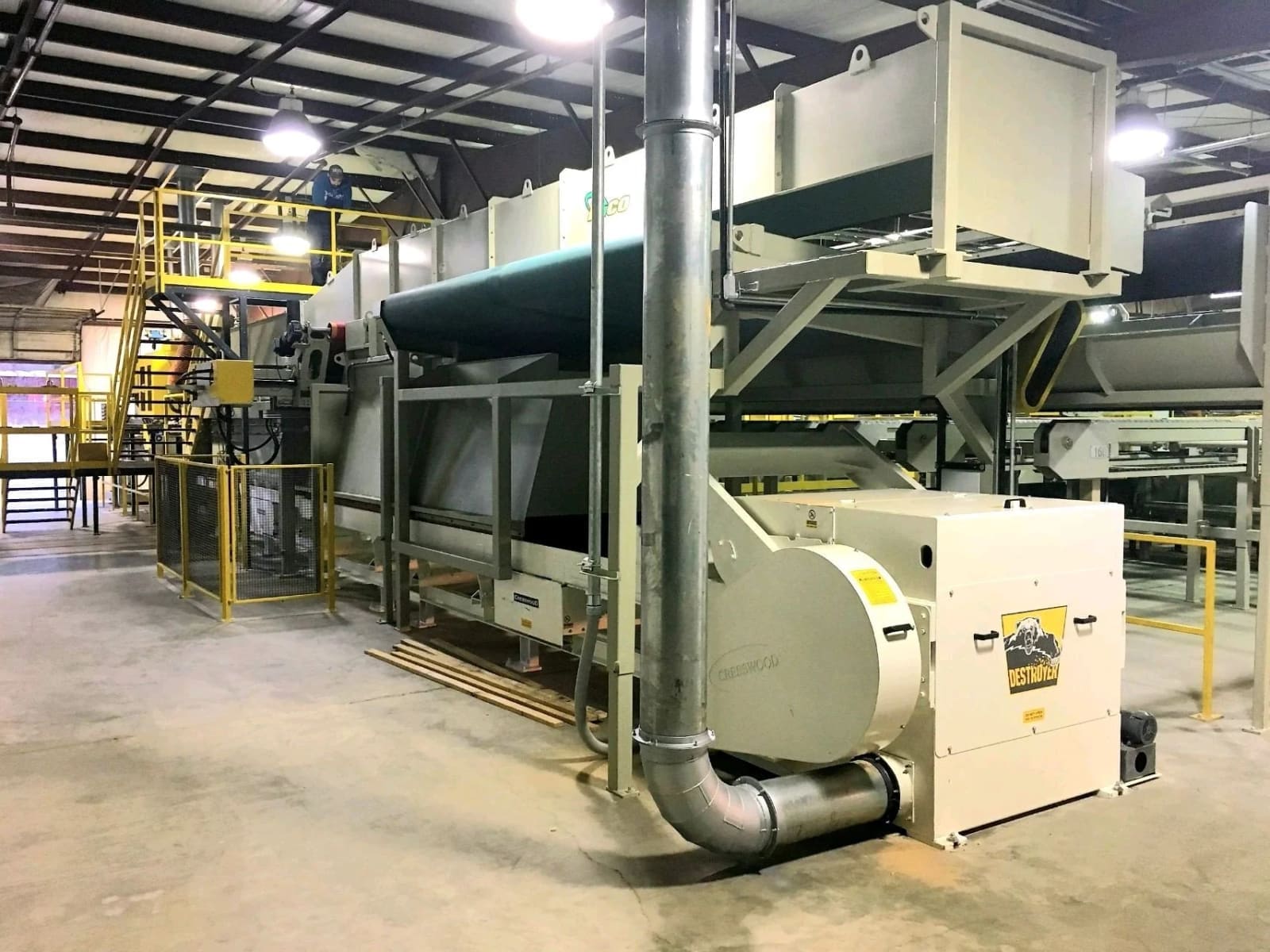
Every mill and flooring plant produces a constant stream of offcuts, trim, and broken pallets. Hauling it away is a rising cost line; ground consistently, it becomes boiler fuel, animal bedding, or salable byproduct. Cresswood's single-shaft, low-RPM grinders are built for exactly that conversion, running all shift at the back of a production line.
The low-RPM approach grinds with torque rather than speed. That means quieter machines, lower energy per ton, less airborne dust, and a rotor that shrugs off the occasional nail or contaminant instead of exploding a hammer.
The lineup covers the duty range: EF end-feed machines for conveyor-fed streams, HF hopper-feed machines for bulky input, the XR and EXR classes for high-volume pallet and crate destruction, and the SR360 for specialty duty. Cresswood has been at this since the family's first machines in 1963, and everything is engineered and built in Illinois.
The US average landfill tipping fee is now around $62 a ton and rose about 10 percent in 2024, with larger landfills above $70. Pallets are worse, because you are paying for handling as well as tonnage: $1.50 to $3.00 a pallet works out near $75 to $150 a ton. That is the cost you are trying to remove, and it is more predictable than the revenue side.
One thing worth being straight about, because most of the industry is not. Grinding does not shrink every waste stream. Broken pallets, crates and brush are mostly air, so grinding them collapses the pile. Slabs, edgings and trim are close to solid wood, and ground material actually takes up roughly three times the loose volume the solid pieces did. What you gain there is a material that flows, meters and blows into a trailer instead of bridging in a bin, and one you can sell. If someone tells you grinding will cut your waste volume regardless of what you are feeding it, they have not asked what you are feeding it.
| Technology | Single-shaft, low-RPM shredding and grinding |
|---|---|
| Feed styles | End-feed (EF series) and hopper-feed (HF series) |
| Model lines | EF-12SR to EF-60LR, SR360, XR400 to XR2400, EXR-2000 |
| Materials | Wood, pallets, flooring offcuts, plastic, paper |
| Engineering | Designed, engineered and manufactured in-house in the USA |
| Support | Cresswood service and maintenance programs |
| Model range | 15 models: EF-12SR, EF-24SR, EF-36SR, EF-48SR, EF-30LR, EF-50LR, EF-60LR, EXR-2000, SR-300, SR-360, XR-400, XR-500, XR-600, XR-700, XR-2400 |
| Motor power | 25 HP on the EF-12SR up to 200 HP on the XR-2400 and EXR-2000 |
| Rotor diameter | 10 in, 16 in, 20 in and 24 in depending on model |
| Rotor speed | 400 to 600 rpm on end-feed SR and LR models; 600 to 700 rpm on the EXR-2000; 50 to 150 rpm on hopper-fed SR and XR models |
| Cutter teeth | 20 on the EF-12SR up to 108 on the EF-60LR |
| Hopper volume | 1.5 to 7.5 cubic yards mid-range on hopper-fed models |
| Input capacity, end-feed | 4 in x 12 in on the EF-12SR up to 9 11/16 in x 69 1/2 in on the EXR-2000 |
| Cutting chamber, hopper-fed | 30 in x 39 in on the SR-300 up to 70 in x 78 in on the XR-2400 |
| Shipping weight | 2,800 lbs on the EF-12SR up to 29,000 lbs on the XR-2400 |
| Frame thickness | 5/8 in, 3/4 in or 1 in steel plate depending on model |
| Output tuning | Output is optimized per application by selecting different screens, amount of cutter teeth, cutter teeth placement, and rotor selection |
| Rebuild program | Ever New Technology allows replacement of all key wear items to bring the machine back to like-new standards |
| Manufacturing | Family-owned midwestern manufacturer with in-house engineering, design and manufacturing; built in Cortland, Illinois |
Specifications vary by configuration. Every line is engineered to the mill, so request numbers for your application.
Mills rarely buy one machine. These are the systems that most often go in with a shredders & grinders, and quoting them together is how the handoffs get engineered before anyone orders steel.
We are the manufacturer's own U.S. representative, so the engineering answers come from the people who build the machine and you reach them through one number.
We quote and support installations across the United States, from the Southeast to the Pacific Northwest.
Ripping, edging, scanning, sorting, stacking and waste handling on one quote, with the handoffs between them worked out before you order.
Low-RPM single-shaft machines grind with high torque instead of high speed: quieter operation, lower energy per ton, less dust, and better tolerance of contaminants than high-speed hammer-style grinders.
End-feed EF models suit conveyor-fed offcut streams, hopper-feed HF and XR models take bulky material like pallets and crates, and the EXR-2000 and SR360 cover heavy-duty and specialty applications. Spec sheets for each series are on this page.
Wood scrap, pallets, flooring and moulding offcuts, plastic, and paper. Mixed streams are commonly ground into boiler fuel or animal bedding.
Cresswood engineers and manufactures in Illinois and backs the machines with its own service and maintenance programs. Several of the routine jobs, anvil replacement, screen removal and ram adjustment, are covered in the maintenance videos on our videos page.
Sizing, options, budget numbers and lead times, in one conversation.