The builder's own engineering
We are the manufacturer's own U.S. representative, so the engineering answers come from the people who build the machine and you reach them through one number.

OSI Machinerie builds self-centering planers, profilers and end matchers in Saint-Georges, Quebec, the same town as Lico and EBI. A self-centering planer takes material off both faces and holds thickness to plus or minus 0.003 in, which is what makes it useful in places a conventional planer cannot go.
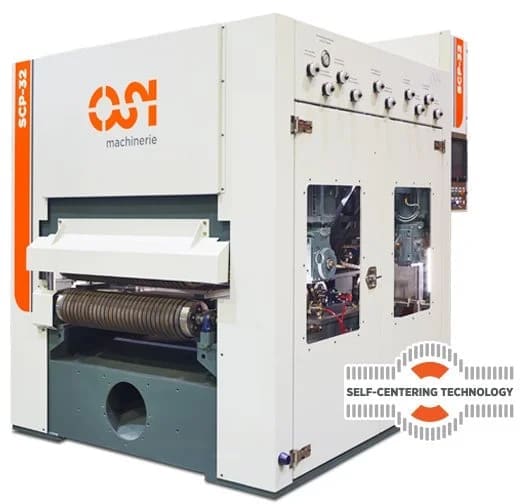
OSI Machinerie builds in Saint-Georges, Quebec, which is the same town as Lico and EBI. That is a coincidence of geography rather than a corporate relationship, but it is a useful one: three of the four lines we carry are built within a short drive of each other, by people who know each other's machines.
The range is narrow and deliberate. Self-centering planers in four sizes, a profiler, and a family of end matchers. There is no attempt to cover everything a mill might want, which is generally a good sign in machinery.
A conventional planer presses one face of the board against a bed and cuts the other. Whatever shape the board had going in, the reference is the bed, so cup and twist tend to be reproduced rather than removed.
A self-centering machine works both faces and splits the cut, referencing the material itself. The finished piece comes out centered on its own thickness, and OSI guarantees plus or minus 0.003 in on it. On the SM-450 profiler the figure is plus or minus 0.002 in, on pieces down to nine inches, which is short enough to matter on a flooring line where the minimum usable piece is exactly that sort of length.
The two obvious places for a planer are before a scanner, where a clean face makes the optimizer's job easier, and after a ripsaw, where OSI's design lets it take strips that would defeat a conventional machine.
The third is more interesting and almost nobody is selling it. Surfacing stock before it goes into the kiln makes thickness more uniform going in, and uniform stock dries more evenly. Drying is usually the hard capacity ceiling in a hardwood operation, more so than any saw, and it is the most expensive thing to add to. Anything that makes the kilns you already own behave more predictably is worth costing properly, and it is not a conversation most equipment suppliers will start with you.
OSI equipment is nearly always specified as part of a station rather than on its own, because where you put it decides which model you need. We quote it with the builder's own engineering behind it and one number to call. If you are already looking at a rip line or scanning, this is the right time to work out whether surfacing belongs in the same project.
| Model | What it is | Notes |
|---|---|---|
| SCP-18 | Self-centering planer | 18 in working width, feeds up to 350 ft/min |
| SCPs-18 | Self-centering planer | 18 in, slower feed variant |
| SCP-24 | Self-centering planer | 24 in working width |
| SCP-32 | Self-centering planer | 32 in, the widest in the series |
| SM-450 | Profiler | Plus or minus 0.002 in, feeds pieces down to 9 in |
| EM-60 / EM-95 / EM-135 | End matchers | For the end-match line |
Configurations vary by mill. Ask which one fits your line.
Before a scanner. A scanner reads what it can see, and a rough face hides defects and confuses geometry. Surfacing first gives the optimizer a clean look at the board, which improves every decision it makes downstream.
After a ripsaw. OSI's own position is that theirs is the planer that can take strips straight off a rip line. Because it centers on the material rather than referencing one face against a bed, it handles narrow strips that a conventional planer would struggle to hold.
Before the kiln. This is the one most mills have never been offered. Presurfacing green stock before drying makes thickness more uniform going in, and more uniform stock dries more evenly and more predictably. Kiln time is capacity, and capacity you recover this way is capacity you did not have to build.
We are the manufacturer's own U.S. representative, so the engineering answers come from the people who build the machine and you reach them through one number.
We quote and support installations across the United States, from the Southeast to the Pacific Northwest.
Ripping, edging, scanning, sorting, stacking and waste handling on one quote, with the handoffs between them worked out before you order.
The machine references the material itself rather than pressing one face against a bed and cutting the other. Heads work from both sides and split the cut, so the finished piece is centered on its own thickness. That is why it holds tolerance on stock that is not already flat.
It is a working-width and feed-speed decision. The SCP Series runs from 18 in through 24 in to 32 in, with feeds up to 350 ft/min on the main models. Tell us the widest piece you run and how fast the line ahead of it moves.
That is OSI's own claim for the machine, and it is the reason it comes up in flooring plants. Strips coming off a rip line are narrow and not necessarily flat, which is exactly the case a self-centering design is built for. It is worth confirming against your actual strip sizes when we scope it.
No. The company we represent is OSI Machinerie of Saint-Georges, Quebec, which builds planers, profilers and end matchers for the wood industry.
We quote and support OSI equipment nationwide with the builder's engineering behind the quote. Call Mike Rose on 615-948-9983.
Four builders, one contact. Each line picks up where the last leaves off, and most mills end up specifying two of them together.
Sizing, options, budget numbers and lead times, in one conversation.