Your line first
We start from what you run, the machines either side and the space you have, and work out whether this one fits before anyone talks price.

Neural Grader builds AI grading scanners and the software that turns each scan into a cut, a grade or a sort. It builds for hardwood and softwood sawmills, component and furniture plants, and lamella producers for engineered flooring. The company is part of the Fordaq group, and its scanner range launched at LIGNA 2025.
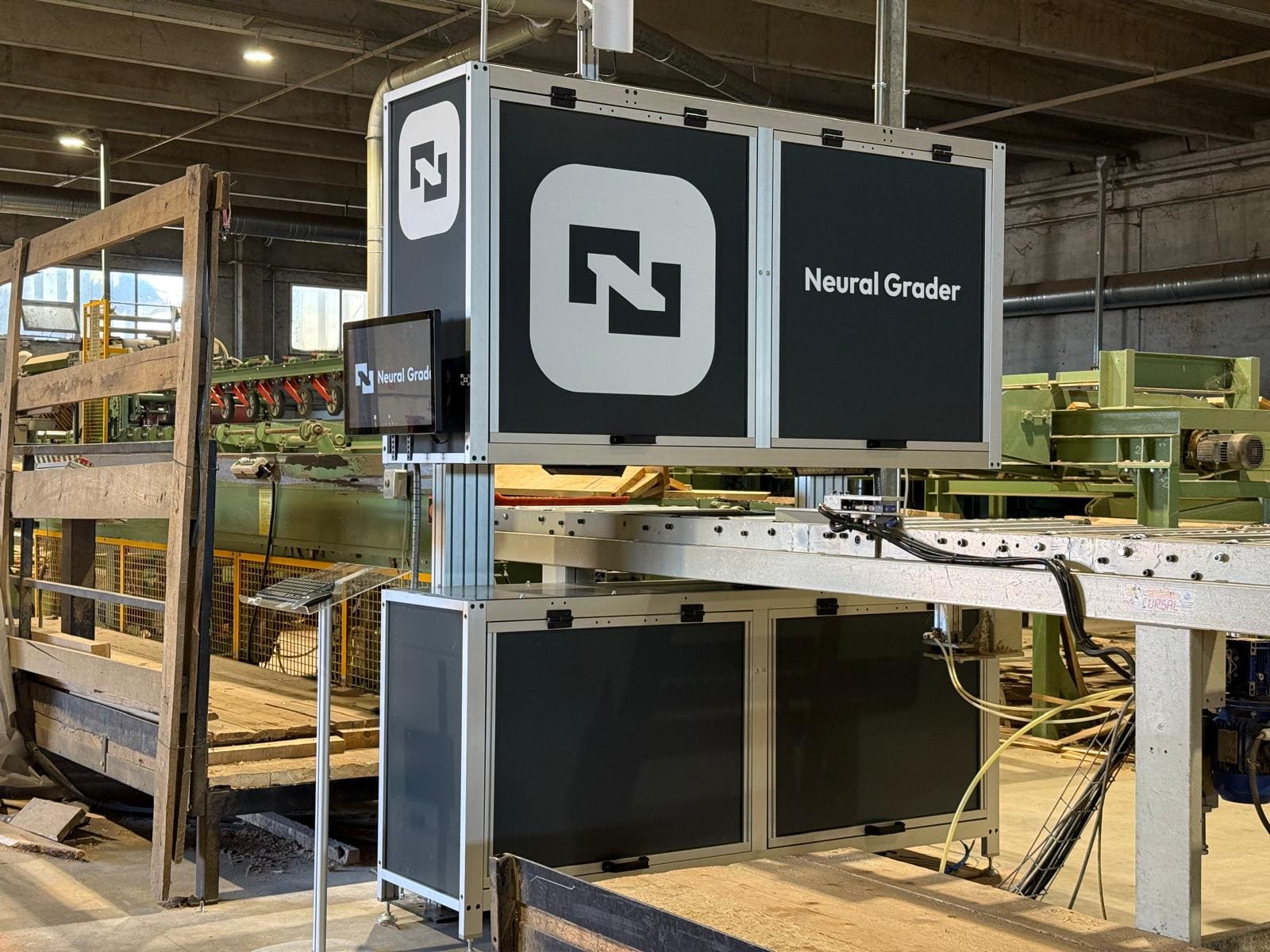
The Nieuwenhuys brothers founded Neural Grader, and it sits in the Fordaq group next to Fordaq.com, a marketplace for wood products that started 25 years ago, and Tally Express, an app for measuring bundles. Benoit Nieuwenhuys runs it as CEO and Bruno Nieuwenhuys is CTO. The chairman, Sampsa Auvinen, has more than 30 years of executive leadership in the forest industry and chairs the European Confederation of Woodworking Industries (CEI-Bois).
The scanner range launched at LIGNA 2025. Neural Grader's published production install is a Linear Compact on the beech grading line at Pomeranian Timber in Poland, and the company says it works with all equipment manufacturers. If the scanner is going onto a line you already run, test that claim first.
Neural Grader says its aim is to make the wood industry more profitable by getting more revenue out of the same wood, and it treats the installation as the first step of the work with a customer.
The scanners read each board on 2 or 4 faces, depending on the model, with industrial cameras, and measure it with lasers. A deep learning engine trained on more than 100,000 boards grades it to NHLA rules, European standards, JAS or the plant's own rules. The software then turns the grade into an instruction: trim and edge cuts at a sawmill, a rip and crosscut solution in a component plant, plus the sort, the board ID and the bundle each piece goes into.
The three models differ in how boards travel past the scan point. Every specification, the software module by module and the Pomeranian line in detail are on the Neural Grader scanner page.
Neural Grader publishes up to 300 boards a minute on the Transversal and the Linear Compact, plus or minus 0.2 mm (about 0.008 in) on laser measurement, and installation in 3 to 4 days on an existing line, with the line down for 1 of those days on the Compact.
There is no published yield, payback or grading-accuracy figure behind those, and no price list. Ask for numbers from a line like yours before you build a case on them.
Bring three things to the first call: what you cut and in which species, how boards cross the point where a scanner would sit, and which machines downstream would act on its decisions. If you are also weighing EBI scanning or a Lico rip or crosscut line, put them on the same call, because the scanner and the saws get specified together.
| Model | The line it is built for | What it reads |
|---|---|---|
| NG Transversal | Transversal lines, green or kiln-dried lumber | 2 or 4 faces, up to 300 boards a minute |
| NG Linear Compact | Linear lines with up to 3 boards side by side, where space is short | 2 or 4 faces, up to 300 boards a minute, in about 600 mm (24 in) of line |
| NG Linear XXL | Linear lines with more than 3 boards side by side | Top and bottom faces, up to 8 boards at once |
| Software platform | Runs behind all three | Measurement, defects, grading, cut optimization, sorting, board ID, reporting and bundles |
Configurations vary by mill. Ask which one fits your line.
At a sawmill, ahead of the trimmer and the edger. The scanner grades the board and works out the trim and edge cuts worth the most, then passes them to the machine, or to the operator where the machine cannot take instructions. Board IDs, sorts and bundle tallies come off the same scan.
In a component, furniture or flooring plant, ahead of the rip saw and the crosscut. Here the software works out rip and crosscut solutions for yield and the plant's own priorities on dimensions. Those are the same kinds of machine as a Lico rip line or an optimized crosscut, and whether a given machine can take its instructions directly is settled when the job is scoped.
On a line with no room for a scanner. The Linear Compact needs about 600 mm (24 in) of conveyor, and Neural Grader built it for lines where older equipment, the conveyor or the building leave no space for a bigger frame.
We start from what you run, the machines either side and the space you have, and work out whether this one fits before anyone talks price.
We quote and support installations across the United States, from the Southeast to the Pacific Northwest.
Ripping, edging, scanning, sorting, stacking and waste handling on one quote, with the handoffs between them worked out before you order.
Neural Grader, which is part of the Fordaq group alongside the Fordaq.com wood marketplace and the Tally Express bundle measurement app. The Nieuwenhuys brothers founded it. Benoit Nieuwenhuys is CEO, Bruno Nieuwenhuys is CTO, and the chairman, Sampsa Auvinen, chairs the European Confederation of Woodworking Industries (CEI-Bois).
Neural Grader says it works with all equipment manufacturers. Its software sends decisions to trimmers, edgers, sorting lines and printers over Ethernet, an API, a PLC or Modbus, and where a machine cannot take them it gives the operator the same decision as an instruction. Which of your machines can act on it directly is something to check against the line itself.
Both read a board and hand a decision to the machine downstream. Neural Grader builds three AI scanners around how boards travel on the conveyor, with its own grading, optimization, sorting and bundle software. EBI builds the Inspector grading and end-match scanners and crosscut optimization. The answer depends on your product, your conveyor and the machines the scanner has to drive, so it is worth looking at both against your line in the same conversation.
Call Mike Rose on 615-948-9983. The first conversation is about your line, and it is the same call whether you want one station quoted or a whole line.
Five builders, one contact. Each line picks up where the last leaves off, and most mills end up specifying two of them together.
Sizing, options, budget numbers and lead times, in one conversation.